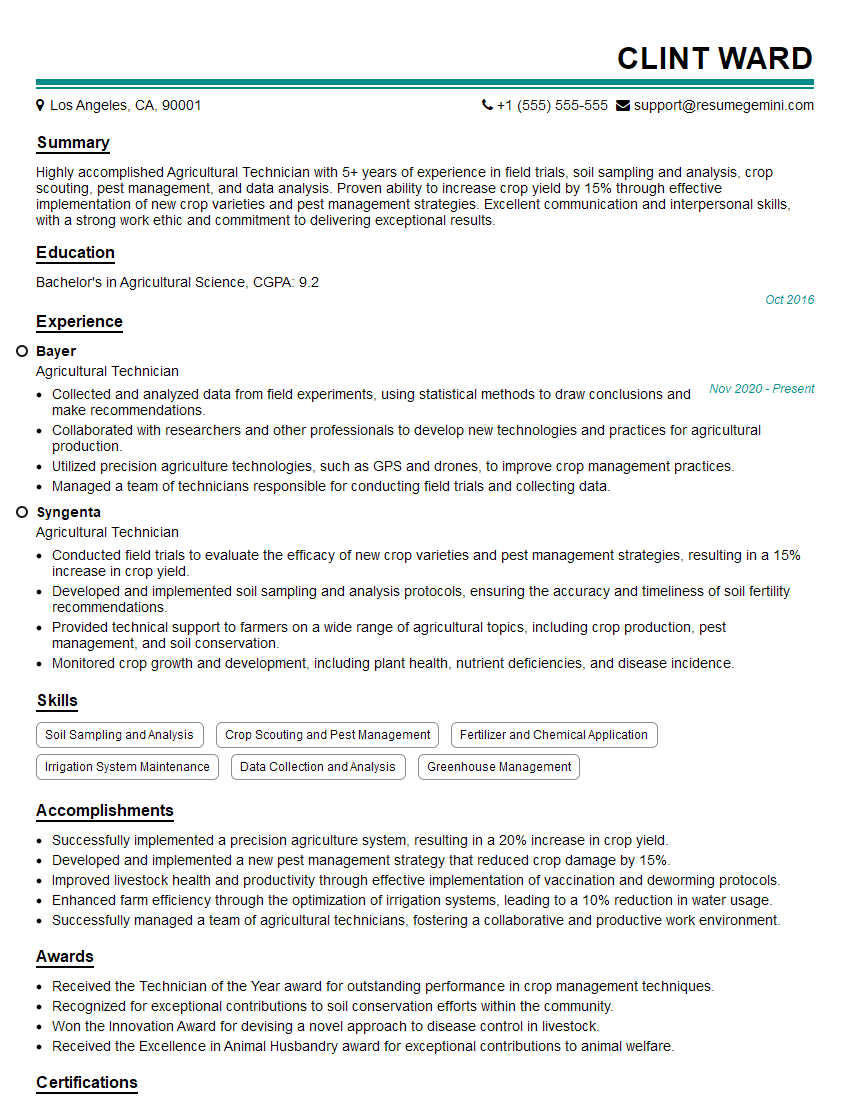
Are you gearing up for an interview for a Agricultural Technician position? Whether you’re a seasoned professional or just stepping into the role, understanding what’s expected can make all the difference. In this blog, we dive deep into the essential interview questions for Agricultural Technician and break down the key responsibilities of the role. By exploring these insights, you’ll gain a clearer picture of what employers are looking for and how you can stand out. Read on to equip yourself with the knowledge and confidence needed to ace your next interview and land your dream job!
Acing the interview is crucial, but landing one requires a compelling resume that gets you noticed. Crafting a professional document that highlights your skills and experience is the first step toward interview success. ResumeGemini can help you build a standout resume that gets you called in for that dream job.






Essential Interview Questions For Agricultural Technician
1. What are the key responsibilities of an Agricultural Technician?
- Conducting soil and water testing
- Developing and implementing crop production plans
- Providing technical assistance to farmers
- Conducting research and field trials
- Monitoring crop health and diagnosing problems
2. What are the educational requirements for an Agricultural Technician?
Bachelor’s degree in agricultural science or a related field
Certification in soil testing, water testing, or crop production
3. What are the key skills required for an Agricultural Technician?
Expertise in soil and water testing
Knowledge of crop production practices
Strong communication and interpersonal skills
Ability to work independently and as part of a team
Problem-solving and critical thinking skills
4. What are the different types of Agricultural Technicians?
Soil Scientists
Water Quality Specialists
Crop Production Specialists
5. What are the career prospects for Agricultural Technicians?
Opportunities for advancement into management roles
Job security in the agricultural industry
Opportunities for professional development and growth
6. What are the challenges facing Agricultural Technicians?
Increasing demand for food production
Climate change and its impact on crop yields
Advances in technology and the need to stay up-to-date
7. How do you stay up-to-date on the latest developments in agricultural technology?
- Attending conferences and workshops
- Reading industry publications
- Networking with other professionals
8. Describe a situation where you had to troubleshoot a crop production problem. How did you approach the problem and what was the outcome?
I was working on a farm where the corn crop was not producing as expected. I started by conducting soil and water tests to rule out any nutrient deficiencies or imbalances. The tests came back normal, so I started to look at other factors that could be affecting the crop. I noticed that the plants were showing signs of drought stress, even though there had been recent rainfall. I dug down into the soil and found that the roots were not able to penetrate the hardpan layer below the surface. I recommended that the farmer break up the hardpan layer to allow the roots to access more water and nutrients. The farmer followed my recommendation, and the crop yield improved significantly.
9. What are your strengths and weaknesses as an Agricultural Technician?
Strengths:
- Strong technical skills in soil and water testing
- Excellent knowledge of crop production practices
- Strong communication and interpersonal skills
Weaknesses:
- Limited experience in managing large-scale crop production operations
- Not yet certified in all areas of agricultural technology
10. Why are you interested in working as an Agricultural Technician for our company?
I am impressed by your company’s commitment to sustainable agriculture and your focus on providing innovative solutions to farmers. I believe that my skills and experience would be a valuable asset to your team. I am eager to learn more about your company and how I can contribute to your mission.
Interviewers often ask about specific skills and experiences. With ResumeGemini‘s customizable templates, you can tailor your resume to showcase the skills most relevant to the position, making a powerful first impression. Also check out Resume Template specially tailored for Agricultural Technician.
Career Expert Tips:
- Ace those interviews! Prepare effectively by reviewing the Top 50 Most Common Interview Questions on ResumeGemini.
- Navigate your job search with confidence! Explore a wide range of Career Tips on ResumeGemini. Learn about common challenges and recommendations to overcome them.
- Craft the perfect resume! Master the Art of Resume Writing with ResumeGemini’s guide. Showcase your unique qualifications and achievements effectively.
- Great Savings With New Year Deals and Discounts! In 2025, boost your job search and build your dream resume with ResumeGemini’s ATS optimized templates.
Researching the company and tailoring your answers is essential. Once you have a clear understanding of the Agricultural Technician‘s requirements, you can use ResumeGemini to adjust your resume to perfectly match the job description.
Key Job Responsibilities
An Agricultural Technician supports agricultural scientists and researchers in conducting experiments, analyzing data, and providing technical assistance in the field of agriculture. Their key responsibilities include:
1. Fieldwork and Data Collection
Assist in the design and implementation of field experiments, collect data on crop growth, soil conditions, and other relevant parameters
- Set up and maintain experimental plots, ensuring proper irrigation, fertilization, and pest control
- Collect and record data on plant growth, yield, and other metrics, using appropriate measurement techniques
2. Laboratory Analysis
Conduct laboratory analyses of soil, plant, and water samples to determine their chemical and physical properties
- Use analytical techniques such as spectrophotometry, chromatography, and microscopy to identify and quantify components
- Interpret laboratory results and prepare reports summarizing findings
3. Technical Assistance
Provide technical assistance to farmers, researchers, and other stakeholders on various agricultural topics
- Conduct workshops and training sessions on best practices in crop production, soil management, and pest control
- Collaborate with extension specialists to disseminate research findings and promote the adoption of new technologies
4. Equipment Maintenance and Calibration
Maintain and calibrate agricultural equipment, including tractors, planters, and harvesting machinery
- Perform regular inspections, repairs, and adjustments to ensure equipment is in good working condition
- Follow safety protocols and maintain a clean and organized work environment
Interview Tips
To prepare for an interview for an Agricultural Technician position, consider the following tips:
1. Research the Company and Role
Familiarize yourself with the company’s mission, values, and the specific requirements of the role you’re applying for. This will help you tailor your answers and demonstrate your understanding of the industry.
- Visit the company’s website and social media pages
- Read industry publications and articles to stay up-to-date on the latest agricultural trends and technologies
2. Highlight Your Technical Skills
Emphasize your proficiency in laboratory techniques, data analysis, and equipment maintenance. Use specific examples to showcase your abilities and how they have contributed to successful research projects.
- Quantify your accomplishments whenever possible, for instance, “Improved crop yield by 15% through the implementation of a new soil management strategy”
- Be prepared to discuss your experience with specific analytical techniques, such as spectrophotometry or microscopy
3. Demonstrate Your Communication and Interpersonal Skills
Agricultural Technicians often work closely with farmers, researchers, and extension specialists. Highlight your ability to communicate effectively, both verbally and in writing.
- Share examples of successful collaborations or presentations you have been involved in
- Emphasize your ability to listen actively, understand different perspectives, and build strong relationships
4. Prepare for Common Interview Questions
Be prepared to answer common interview questions, such as:
- Tell me about your experience in agricultural research or field operations
- Describe a project where you successfully analyzed data and drew meaningful conclusions
- How do you stay updated on the latest advancements in agricultural technology?
Next Step:
Armed with this knowledge, you’re now well-equipped to tackle the Agricultural Technician interview with confidence. Remember, a well-crafted resume is your first impression. Take the time to tailor your resume to highlight your relevant skills and experiences. And don’t forget to practice your answers to common interview questions. With a little preparation, you’ll be on your way to landing your dream job. So what are you waiting for? Start building your resume and start applying! Build an amazing resume with ResumeGemini.