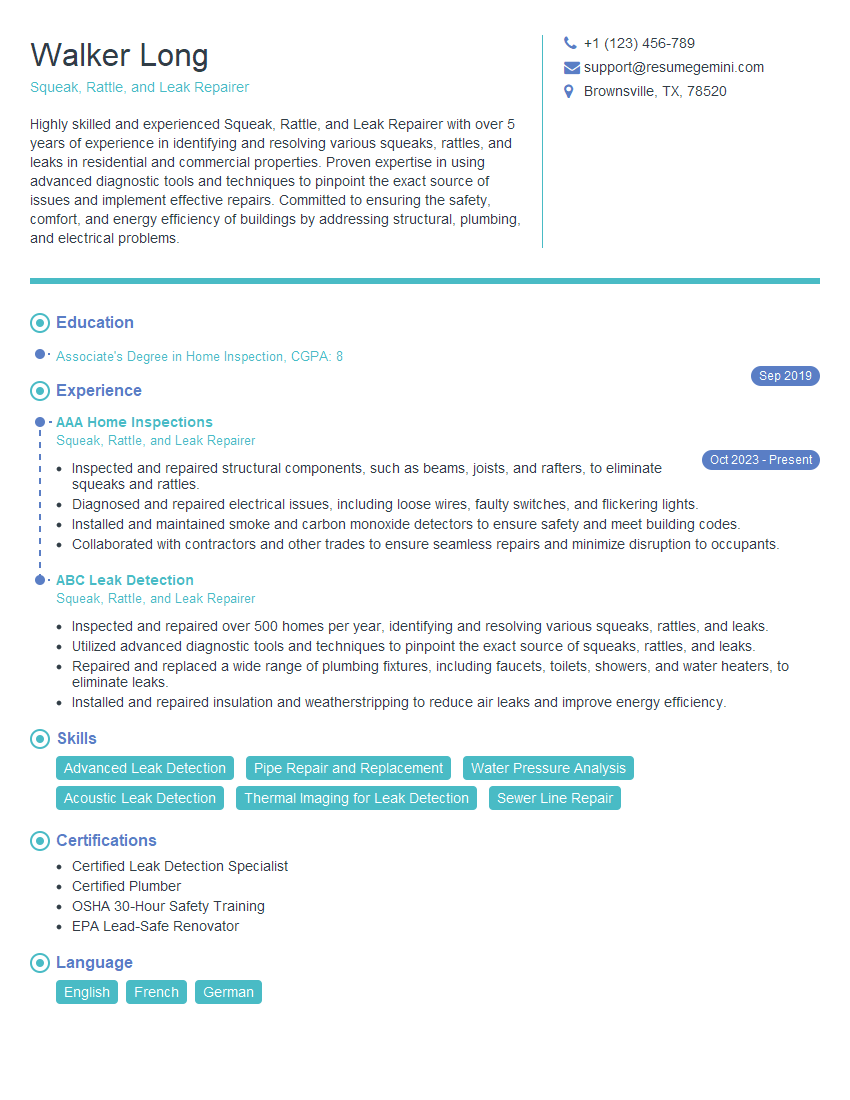
Are you gearing up for a career shift or aiming to ace your next interview? Look no further! We’ve curated a comprehensive guide to help you crack the interview for the coveted Squeak, Rattle, and Leak Repairer position. From understanding the key responsibilities to mastering the most commonly asked questions, this blog has you covered. So, buckle up and let’s embark on this journey together
Acing the interview is crucial, but landing one requires a compelling resume that gets you noticed. Crafting a professional document that highlights your skills and experience is the first step toward interview success. ResumeGemini can help you build a standout resume that gets you called in for that dream job.






Essential Interview Questions For Squeak, Rattle, and Leak Repairer
1. What are the most common sources of leaks in a home, and how would you approach diagnosing and repairing them?
- Plumbing leaks: This could be from a burst pipe, leaking faucet, or faulty toilet. I would start by checking for any visible leaks, then use a moisture meter or infrared camera to detect hidden leaks.
- Roof leaks: These are typically caused by missing or damaged shingles, flashing issues, or clogged gutters. I would inspect the roof for any damage, then use a hose to test for leaks.
- Window and door leaks: This could be caused by damaged weatherstripping, sealant, or flashing. I would inspect the window or door for any gaps, then use a hose or caulk gun to seal them.
- Foundation leaks: This could be caused by cracks or damage to the foundation. I would inspect the foundation for any visible damage, then use a moisture meter to detect any hidden leaks.
2. Describe the different types of materials and techniques used for repairing leaks, and how to choose the best option for a specific situation.
Materials
- Caulk: This is a flexible material used to seal gaps and cracks. It is available in a variety of colors and can be applied with a caulk gun.
- Silicone: This is a waterproof sealant used to seal gaps and cracks. It is more expensive than caulk, but it is more durable.
- Expanding foam: This is a foam that expands to fill gaps and cracks. It is a good option for filling larger holes.
- Hydraulic cement: This cement is used to repair leaks in concrete and masonry. It is very strong and durable.
Techniques
- Patching: This involves applying a patch over the leak. This is a good option for small leaks.
- Grouting: This involves filling in cracks and joints with grout. This is a good option for tile leaks.
- Re-piping: This involves replacing the entire pipe system. This is a good option for large leaks or leaks in inaccessible locations.
3. How would you approach identifying and repairing a leak in an underground pipe?
- Use a moisture meter: This device can detect moisture in the ground, which can indicate the presence of a leak.
- Use a listening device: This device can amplify the sound of running water, which can help you locate the leak.
- Excavate the area: Once you have located the leak, you will need to excavate the area to expose the pipe.
- Repair the leak: This may involve patching the pipe, replacing a section of pipe, or re-piping the entire area.
4. What are some common safety hazards associated with squeak, rattle, and leak repair, and how can they be mitigated?
- Electrical hazards: This includes working with live wires and electrical equipment. Mitigate this by turning off the power at the main breaker before working on any electrical components.
- Water hazards: This includes working with water and moisture. Mitigate this by wearing appropriate clothing and protective gear, and by keeping work areas dry.
- Sharp objects: This includes working with nails, screws, and other sharp objects. Mitigate this by wearing gloves and eye protection, and by using sharp objects carefully.
- Heavy objects: This includes lifting and moving heavy objects. Mitigate this by using proper lifting techniques and asking for help when necessary.
5. What are some common tools and equipment used for squeak, rattle, and leak repair, and how do you use them?
- Plumber’s wrench: This is used to tighten and loosen nuts and bolts on plumbing fixtures.
- Pipe wrench: This is used to tighten and loosen pipes.
- Caulk gun: This is used to apply caulk to seal gaps and cracks.
- Moisture meter: This is used to detect moisture in the ground or walls.
- Listening device: This is used to amplify the sound of running water to locate leaks.
6. How would you troubleshoot and repair a noisy squeak or rattle in a building?
- Identify the source of the noise: This may involve listening for the noise and checking for loose or vibrating objects.
- Tighten or lubricate loose objects: This may involve tightening screws, bolts, or nuts, or applying lubricant to moving parts.
- Replace worn or damaged parts: This may involve replacing squeaky door hinges or rattling window panes.
7. What is the difference between a soft leak and a hard leak in a water pipe, and how would you approach repairing each type?
- Soft leak: This is a leak that is slow and steady. It may be caused by a loose fitting or a small crack in the pipe.
- Hard leak: This is a leak that is sudden and forceful. It may be caused by a burst pipe or a large crack in the pipe.
- Repairing a soft leak: This may involve tightening the loose fitting or replacing the cracked pipe section.
- Repairing a hard leak: This may involve shutting off the water supply to the pipe and calling a plumber to replace the damaged section of pipe.
8. How would you handle a situation where a customer is experiencing a plumbing leak and is unable to shut off the water supply?
- Stay calm and assess the situation: Try to determine the source of the leak and the severity of the damage.
- Call a plumber: If the leak is severe or you are unable to stop it yourself, call a plumber immediately.
- Help the customer minimize damage: If the leak is small and you are able to stop it, help the customer move valuables away from the area and contain the water.
9. What are some tips for preventing squeaks, rattles, and leaks in a home?
- Regularly inspect your home for potential problems: This includes checking for loose screws, bolts, and nuts, and for any signs of water leaks.
- Tighten or lubricate loose objects: This will help to prevent squeaks and rattles.
- Fix water leaks promptly: This will help to prevent further damage to your home.
- Use caulk or sealant to seal gaps and cracks: This will help to prevent water leaks and drafts.
10. What are some of the latest advancements in squeak, rattle, and leak repair technology that you are aware of?
- Thermal imaging: This technology can be used to detect hidden leaks by detecting changes in temperature.
- Acoustic leak detection: This technology can be used to locate leaks by amplifying the sound of running water.
- Smart leak detectors: These devices can be installed in your home to automatically detect leaks and shut off the water supply.
Interviewers often ask about specific skills and experiences. With ResumeGemini‘s customizable templates, you can tailor your resume to showcase the skills most relevant to the position, making a powerful first impression. Also check out Resume Template specially tailored for Squeak, Rattle, and Leak Repairer.
Career Expert Tips:
- Ace those interviews! Prepare effectively by reviewing the Top 50 Most Common Interview Questions on ResumeGemini.
- Navigate your job search with confidence! Explore a wide range of Career Tips on ResumeGemini. Learn about common challenges and recommendations to overcome them.
- Craft the perfect resume! Master the Art of Resume Writing with ResumeGemini’s guide. Showcase your unique qualifications and achievements effectively.
- Great Savings With New Year Deals and Discounts! In 2025, boost your job search and build your dream resume with ResumeGemini’s ATS optimized templates.
Researching the company and tailoring your answers is essential. Once you have a clear understanding of the Squeak, Rattle, and Leak Repairer‘s requirements, you can use ResumeGemini to adjust your resume to perfectly match the job description.
Key Job Responsibilities
Squeak, Rattle, and Leak Repairers are responsible for identifying, diagnosing, and repairing a wide range of issues in residential and commercial buildings. They handle a variety of tasks, including:
1. Noise and Vibration Control
• Identifying noise sources and determining their causes
• Isolating, absorbing, and damping noise and vibration
2. Leak Detection and Repair
• Locating leaks in plumbing, roofing, and other systems
• Repairing leaks and preventing future occurrences
3. Structural Repair
• Evaluating structural integrity and identifying potential hazards
• Repairing cracks, gaps, and other structural deficiencies
4. General Maintenance
• Inspecting buildings for potential issues
• Performing minor repairs and maintenance tasks
Interview Tips
To ace an interview for a Squeak, Rattle, and Leak Repairer position, it’s important to prepare thoroughly and highlight your relevant skills and experience.
1. Research the Company and Industry
• Gather information about the company’s services, clients, and reputation.
• Stay updated on industry trends and best practices.
2. Prepare for Technical Questions
• Brush up on your knowledge of noise control, leak detection, structural repair, and general maintenance.
• Practice answering questions about your experience with specific tools and techniques.
3. Highlight Your Problem-Solving Abilities
• Employers value Squeak, Rattle, and Leak Repairers who can identify and solve problems efficiently.
• Prepare examples of how you have used your problem-solving skills to identify and resolve issues in the past.
4. Demonstrating a Strong Work Ethic
• Emphasize your attention to detail, willingness to work independently, and ability to meet deadlines.
• Highlight your commitment to safety and customer satisfaction.
5. Prepare Example Situations
• Prepare examples of situations where you have successfully identified and resolved noise, leak, or structural issues.
• Use these examples to demonstrate your technical skills and problem-solving abilities.
6. Research the Tools and Equipment
• Familiarize yourself with the types of tools and equipment used in squeak, rattle, and leak repair.
• Be prepared to discuss your experience with specific tools and technologies.
7. Practice Your Presentation Skills
• Ensure you are comfortable presenting your qualifications and experience in a clear and concise manner.
• Practice answering questions and highlighting your strengths.
8. Dress Professionally and Arrive Punctually
• Show up to the interview dressed professionally and on time.
• This demonstrates respect for the interviewer and the company.
Next Step:
Now that you’re armed with the knowledge of Squeak, Rattle, and Leak Repairer interview questions and responsibilities, it’s time to take the next step. Build or refine your resume to highlight your skills and experiences that align with this role. Don’t be afraid to tailor your resume to each specific job application. Finally, start applying for Squeak, Rattle, and Leak Repairer positions with confidence. Remember, preparation is key, and with the right approach, you’ll be well on your way to landing your dream job. Build an amazing resume with ResumeGemini