Ever felt underprepared for that crucial job interview? Or perhaps you’ve landed the interview but struggled to articulate your skills and experiences effectively? Fear not! We’ve got you covered. In this blog post, we’re diving deep into the Art Educator interview questions that you’re most likely to encounter. But that’s not all. We’ll also provide expert insights into the key responsibilities of a Art Educator so you can tailor your answers to impress potential employers.
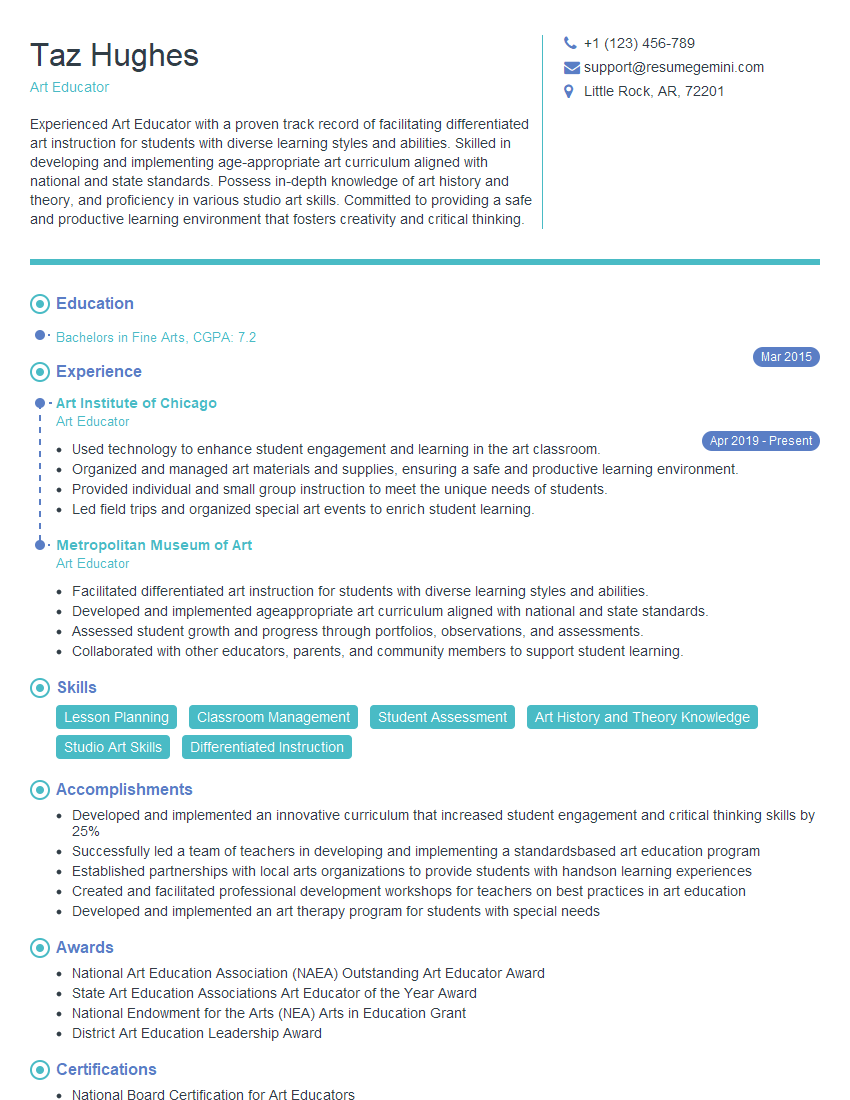
Acing the interview is crucial, but landing one requires a compelling resume that gets you noticed. Crafting a professional document that highlights your skills and experience is the first step toward interview success. ResumeGemini can help you build a standout resume that gets you called in for that dream job.






Essential Interview Questions For Art Educator
1. What are the key elements of a successful art education program?
- A curriculum that is aligned with national and state standards
- Qualified and experienced teachers
- Adequate resources and facilities
- A supportive and collaborative school environment
2. How do you differentiate instruction to meet the needs of all learners?
Strategies for Differentiating Instruction
- Varying the level of difficulty of assignments
- Providing different learning modalities
- Offering choice in activities and assignments
- Creating flexible grouping arrangements
Importance of Differentiated Instruction
- Allows all students to access and engage with the curriculum
- Provides opportunities for students to learn at their own pace and in their own way
- Helps to create a more positive and inclusive learning environment
3. What are your favorite art activities to teach students? Why?
I enjoy teaching a variety of art activities to students, but some of my favorites include:
- Drawing: Drawing is a fundamental skill that can be used to express oneself creatively, develop hand-eye coordination, and improve problem-solving skills.
- Painting: Painting is a great way for students to explore color theory, composition, and texture. It can also be a very relaxing and therapeutic activity.
- Sculpture: Sculpture is a three-dimensional art form that allows students to develop their spatial reasoning skills and creativity. It can also be a lot of fun to work with different materials, such as clay, wood, and paper.
4. How do you assess student learning in art?
I use a variety of assessment methods to evaluate student learning in art, including:
- Observations: I observe students as they work on their projects to assess their progress and understanding of the concepts being taught.
- Rubrics: I use rubrics to assess students’ work on specific criteria, such as creativity, technical skills, and effort.
- Portfolios: I have students create portfolios of their work over time to track their progress and identify areas for growth.
- Student self-reflections: I ask students to reflect on their work and write about their learning process.
5. What are your strategies for classroom management in an art classroom?
I use a variety of classroom management strategies to create a positive and productive learning environment, including:
- Establishing clear rules and expectations
- Providing students with opportunities to make choices
- Using positive reinforcement
- Setting limits
- Building relationships with students and their families
6. How do you stay up-to-date on current trends in art education?
- Attending conferences and workshops
- Reading professional journals and books
- Networking with other art educators
- Taking online courses
- Exploring new technologies and resources
7. What are your thoughts on technology in the art classroom?
I believe that technology can be a valuable tool in the art classroom, but it is important to use it in a way that supports student learning. Some of the benefits of using technology in the art classroom include:
- It can help students to develop their creativity and problem-solving skills.
- It can provide students with access to a wider range of resources and learning opportunities.
- It can help students to share their work with others and get feedback.
8. What are your strengths and weaknesses as an art educator?
Strengths:
- I am a passionate and enthusiastic art educator who loves sharing my love of art with students.
- I am a certified art teacher with several years of experience teaching in K-12 classrooms.
- I have a strong understanding of the curriculum and am able to differentiate instruction to meet the needs of all learners.
- I am a creative and innovative educator who is always looking for new ways to engage students in the learning process.
Weaknesses:
- I am relatively new to the district and am still learning about the school culture and community.
- I would like to develop my skills in using technology in the classroom.
9. What are your goals for the future?
- I hope to continue to grow as an art educator and to learn new ways to engage students in the learning process.
- I would like to develop my skills in using technology in the classroom and to find new ways to incorporate it into my teaching.
- I am interested in pursuing a leadership role in the district and to work with other educators to improve arts education for all students.
10. Why should we hire you?
I believe that I am the best candidate for this position because I am a passionate and experienced art educator who is committed to providing students with a high-quality art education. I am confident that I can make a positive contribution to your school and community.
Interviewers often ask about specific skills and experiences. With ResumeGemini‘s customizable templates, you can tailor your resume to showcase the skills most relevant to the position, making a powerful first impression. Also check out Resume Template specially tailored for Art Educator.
Career Expert Tips:
- Ace those interviews! Prepare effectively by reviewing the Top 50 Most Common Interview Questions on ResumeGemini.
- Navigate your job search with confidence! Explore a wide range of Career Tips on ResumeGemini. Learn about common challenges and recommendations to overcome them.
- Craft the perfect resume! Master the Art of Resume Writing with ResumeGemini’s guide. Showcase your unique qualifications and achievements effectively.
- Great Savings With New Year Deals and Discounts! In 2025, boost your job search and build your dream resume with ResumeGemini’s ATS optimized templates.
Researching the company and tailoring your answers is essential. Once you have a clear understanding of the Art Educator‘s requirements, you can use ResumeGemini to adjust your resume to perfectly match the job description.
Key Job Responsibilities
Art Educators are responsible for planning, implementing, and evaluating art education programs for students of all ages. They work to develop students’ creativity, critical thinking skills, and artistic abilities.
1. Curriculum Development
Develop and implement age-appropriate art curricula that align with state and national standards.
- Create lesson plans and activities that engage students and foster their artistic growth.
- Incorporate various art forms and techniques into the curriculum, including drawing, painting, sculpture, and mixed media.
2. Classroom Instruction
Provide clear and effective instruction to students in a supportive and engaging classroom environment.
- Demonstrate and explain artistic techniques and concepts.
- Guide students through the creative process and encourage them to experiment with different materials and ideas.
3. Student Assessment
Evaluate students’ progress and provide constructive feedback to help them develop their artistic skills and knowledge.
- Use a variety of assessment methods, such as portfolios, rubrics, and self-reflections.
- Provide timely and specific feedback to students to help them improve their work.
4. Classroom Management
Maintain a positive and productive learning environment in the art classroom.
- Establish clear rules and expectations for student behavior.
- Create a safe and welcoming space where students feel comfortable expressing themselves creatively.
Interview Tips
Preparing for an art educator interview requires a combination of research, practice, and confidence. Here are some tips to help you ace the interview:
1. Research the School and Position
Familiarize yourself with the school’s mission, curriculum, and student population. Understand the specific requirements of the art educator position and how your qualifications align with them.
- Visit the school’s website and social media pages to gather information about their programs and initiatives.
- Reach out to current or former art educators at the school to gain insights into the school’s culture and expectations.
2. Prepare a Strong Portfolio
Your portfolio is a crucial component of the interview process. Showcase a diverse range of your artwork and lesson plans that demonstrate your skills, creativity, and teaching ability.
- Include a variety of art forms, such as drawing, painting, sculpture, and mixed media, to highlight your versatility.
- Select examples that illustrate your understanding of art education principles and your ability to engage students.
3. Practice Your Responses
Take time to prepare thoughtful responses to common interview questions. Practice delivering your answers clearly and confidently.
- Consider questions about your teaching philosophy, classroom management strategies, and experience working with diverse student populations.
- Use the STAR method (Situation, Task, Action, Result) to structure your answers and provide specific examples of your skills and accomplishments.
4. Show Your Passion for Art Education
Art educators play a vital role in shaping the lives of young people. Convey your passion for art education and your commitment to nurturing students’ creativity and artistic growth.
- Share anecdotes or experiences that demonstrate your enthusiasm for teaching art.
- Explain how you believe art education can empower students and contribute to their overall development.
Next Step:
Armed with this knowledge, you’re now well-equipped to tackle the Art Educator interview with confidence. Remember, preparation is key. So, start crafting your resume, highlighting your relevant skills and experiences. Don’t be afraid to tailor your application to each specific job posting. With the right approach and a bit of practice, you’ll be well on your way to landing your dream job. Build your resume now from scratch or optimize your existing resume with ResumeGemini. Wish you luck in your career journey!