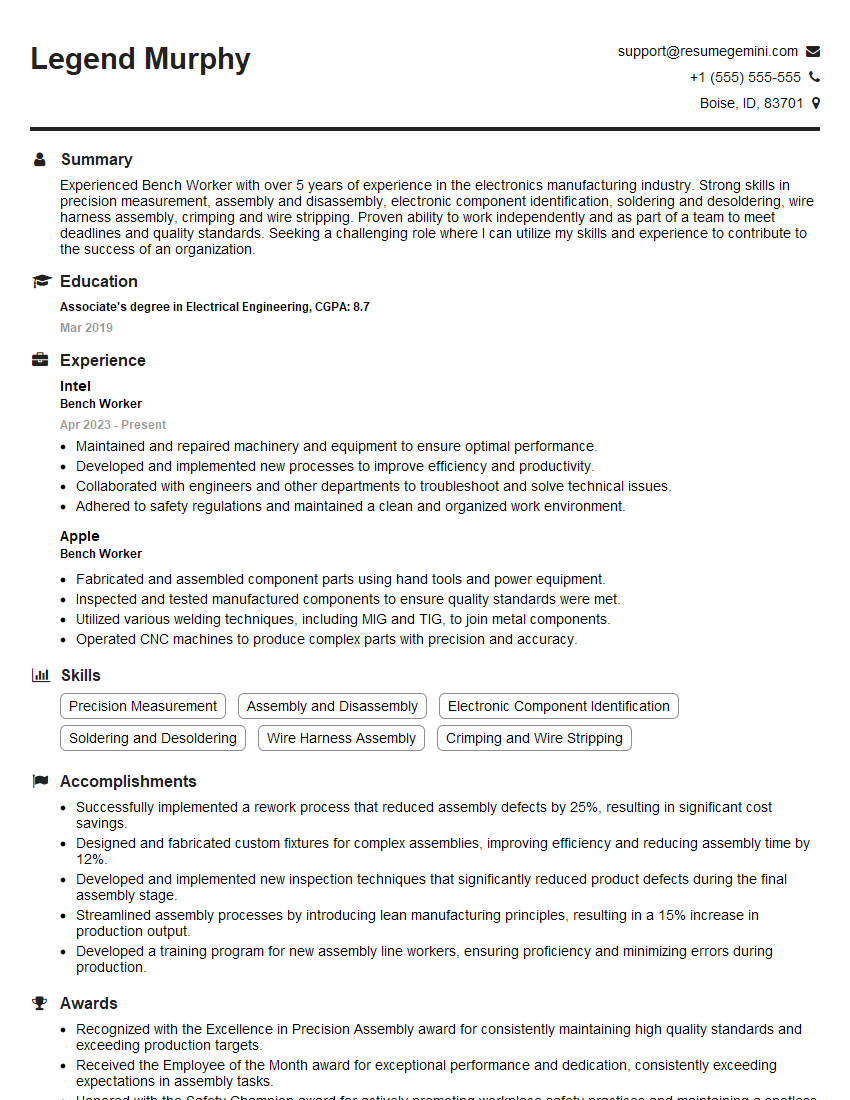
Are you gearing up for a career shift or aiming to ace your next interview? Look no further! We’ve curated a comprehensive guide to help you crack the interview for the coveted Bench Worker position. From understanding the key responsibilities to mastering the most commonly asked questions, this blog has you covered. So, buckle up and let’s embark on this journey together.
Acing the interview is crucial, but landing one requires a compelling resume that gets you noticed. Crafting a professional document that highlights your skills and experience is the first step toward interview success. ResumeGemini can help you build a standout resume that gets you called in for that dream job.






Essential Interview Questions For Bench Worker
1. What are the responsibilities of a bench worker?
- Setting up and operating a variety of machines, such as lathes, mills, and grinders.
- Inspecting and measuring parts to ensure they meet specifications.
- Maintaining and repairing equipment.
- Following blueprints and work orders.
2. How would you handle a situation where you were asked to do a task that you did not know how to do?
- Asking a supervisor or colleague for help.
- Referring to a manual or online resources.
- Trying different approaches until I found one that worked.
3. How do you ensure that your work is accurate and meets specifications?
- Checking my work carefully.
- Using measuring tools and gauges.
- Following blueprints and work orders.
- Asking for feedback from a supervisor or colleague.
4. How do you handle working under pressure?
- Staying calm and focused.
- Prioritizing my tasks.
- Delegating tasks to others when necessary.
- Taking breaks when needed.
5. Why are you interested in this position?
- I have a passion for working with my hands.
- I am eager to learn new skills and develop my abilities.
- I am a hard worker and I am always willing to go the extra mile.
6. What are your strengths and weaknesses as a bench worker?
- Accuracy
- Attention to detail
- Problem-solving skills
- I am sometimes too detail-oriented.
- I can be impatient at times.
Strengths:
Weaknesses:
7. How do you stay up-to-date on the latest industry trends and technologies?
- Reading trade publications.
- Attending industry events.
- Taking online courses.
8. What are your career goals?
- To become a skilled and experienced bench worker.
- To eventually move into a supervisory role.
- To start my own business.
9. What is your work style?
- I am a hard worker and I am always willing to go the extra mile.
- I am a team player and I am always willing to help out my colleagues.
- I am a quick learner and I am always eager to take on new challenges.
10. Do you have any questions for me?
- What is the company culture like?
- What are the opportunities for advancement?
- What is the training program like?
Interviewers often ask about specific skills and experiences. With ResumeGemini‘s customizable templates, you can tailor your resume to showcase the skills most relevant to the position, making a powerful first impression. Also check out Resume Template specially tailored for Bench Worker.
Career Expert Tips:
- Ace those interviews! Prepare effectively by reviewing the Top 50 Most Common Interview Questions on ResumeGemini.
- Navigate your job search with confidence! Explore a wide range of Career Tips on ResumeGemini. Learn about common challenges and recommendations to overcome them.
- Craft the perfect resume! Master the Art of Resume Writing with ResumeGemini’s guide. Showcase your unique qualifications and achievements effectively.
- Great Savings With New Year Deals and Discounts! In 2025, boost your job search and build your dream resume with ResumeGemini’s ATS optimized templates.
Researching the company and tailoring your answers is essential. Once you have a clear understanding of the Bench Worker‘s requirements, you can use ResumeGemini to adjust your resume to perfectly match the job description.
Key Job Responsibilities
Bench Workers are responsible for assembling, testing, and repairing components and products in a manufacturing environment. Some key job responsibilities include:
1. Assembly
Bench Workers assemble components and products according to specifications, using hand tools and power tools.
- Interpret blueprints and work orders to determine assembly requirements.
- Assemble components using hand tools, power tools, and specialized equipment.
- Ensure that assembled products meet quality standards.
2. Testing
Bench Workers test components and products to ensure that they meet specifications.
- Conduct visual inspections to identify defects.
- Use test equipment to verify functionality.
- Record test results and report any discrepancies.
3. Repair
Bench Workers repair components and products that have failed or become damaged.
- Diagnose the cause of the failure.
- Replace or repair defective components.
- Retest the repaired product to ensure that it meets specifications.
4. Quality Control
Bench Workers perform quality control checks on assembled products.
- Inspect products for defects and workmanship.
- Record inspection results and report any non-conformances.
- Participate in quality improvement initiatives.
Interview Tips
Interviews for Bench Worker positions can vary depending on the specific industry and company, but some general tips for preparing and acing the interview include:
1. Research the company and the position
Take the time to research the company you are interviewing with, their products or services, their industry, and the specific Bench Worker position you are applying for. This will help you understand the company’s culture, their needs, and the qualifications they are looking for in a candidate.
2. Practice your answers to common interview questions
There are a number of common interview questions that you are likely to be asked, such as “Tell me about yourself,” “Why are you interested in this position?” and “What are your strengths and weaknesses?” Practice your answers to these questions in advance so that you can deliver them confidently and concisely.
3. Prepare questions to ask the interviewer
Asking thoughtful questions at the end of the interview shows that you are engaged and interested in the position. Prepare a few questions to ask the interviewer about the company, the Bench Worker position, and the team you would be working with.
4. Dress professionally
First impressions matter, so make sure to dress professionally for your interview. This means wearing clean, pressed clothes that are appropriate for the company and the position you are applying for.
5. Be on time
Punctuality is important, so make sure to arrive for your interview on time. Allow yourself plenty of time to get to the interview location, and be sure to factor in any unexpected delays, such as traffic or parking.
6. Be confident
Confidence is key in any interview, but it is especially important for Bench Worker positions. Bench Workers need to be able to work independently and make decisions, so interviewers will be looking for candidates who are confident in their abilities.
Next Step:
Armed with this knowledge, you’re now well-equipped to tackle the Bench Worker interview with confidence. Remember, a well-crafted resume is your first impression. Take the time to tailor your resume to highlight your relevant skills and experiences. And don’t forget to practice your answers to common interview questions. With a little preparation, you’ll be on your way to landing your dream job. So what are you waiting for? Start building your resume and start applying! Build an amazing resume with ResumeGemini.