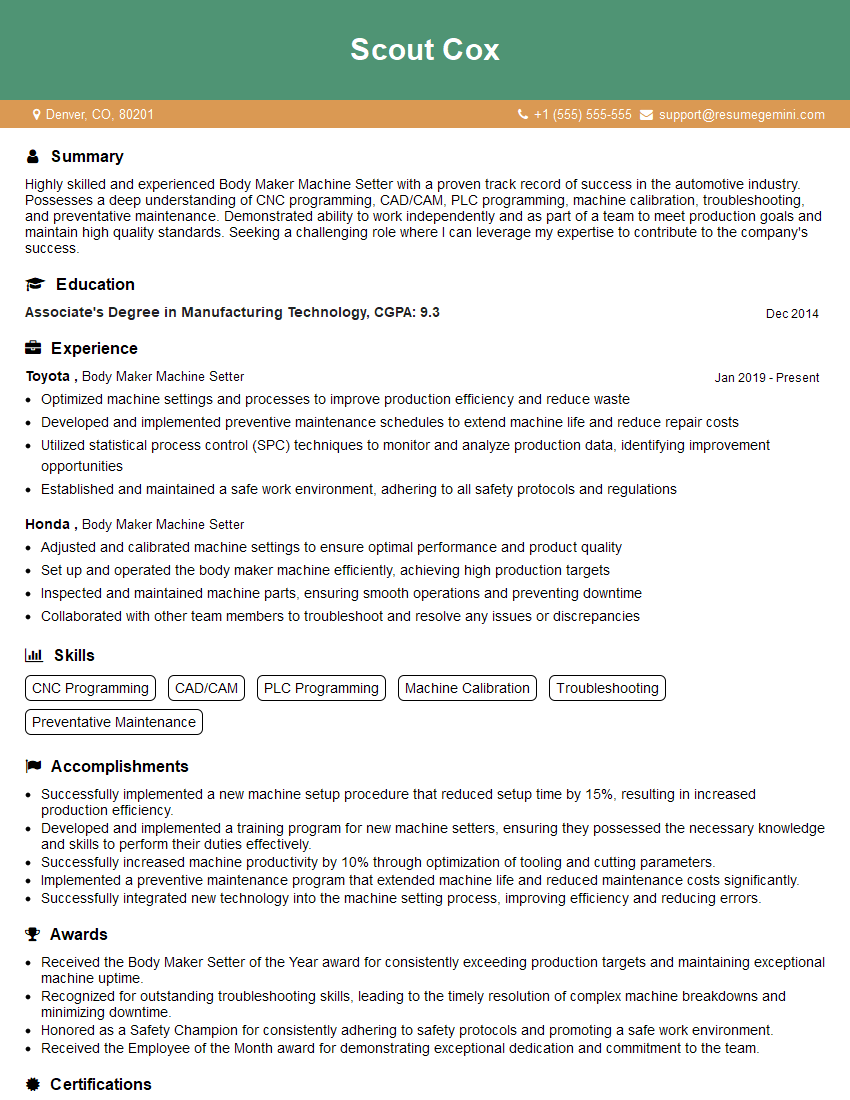
Are you gearing up for a career shift or aiming to ace your next interview? Look no further! We’ve curated a comprehensive guide to help you crack the interview for the coveted Body Maker Machine Setter position. From understanding the key responsibilities to mastering the most commonly asked questions, this blog has you covered. So, buckle up and let’s embark on this journey together
Acing the interview is crucial, but landing one requires a compelling resume that gets you noticed. Crafting a professional document that highlights your skills and experience is the first step toward interview success. ResumeGemini can help you build a standout resume that gets you called in for that dream job.






Essential Interview Questions For Body Maker Machine Setter
1. Explain the process of setting up and calibrating a body maker machine?
Sample Answer:
- Ensure the machine is properly grounded and connected to a stable power source.
- Check the machine’s sensors and actuators for any damage or wear.
- Perform a visual inspection of the machine’s components.
- Power up the machine and run the calibration function.
- Follow the on-screen instructions to calibrate the machine’s sensors and actuators.
- Verify the calibration by measuring the machine’s accuracy with a known-good sample.
- Record the calibration results for future reference.
2. How do you ensure that the body maker machine is producing parts within the specified tolerances?
: In-Process Monitoring
- Monitor the machine’s output data, such as force, displacement, and temperature, during operation.
- Use statistical process control (SPC) charts to track the machine’s performance over time.
- Set up automatic shut-off systems to prevent the machine from producing out-of-tolerance parts.
Subheading: Post-Process Inspection
- Inspect the produced parts against the specified tolerances using calipers, gauges, or measuring machines.
- Use non-destructive testing techniques, such as ultrasonic or eddy current inspection, to detect internal defects.
- Document the inspection results for quality control purposes.
3. Describe the different types of body maker machines and their applications?
- Press brake: Used for bending metal sheets into complex shapes.
- Shear: Used for cutting metal sheets.
- Punch: Used for creating holes in metal sheets.
- Roll forming: Used for forming metal sheets into continuous profiles.
- Extrusion: Used for creating metal parts with complex cross-sections.
4. What is the role of preventive maintenance in the operation of a body maker machine?
- Regularly clean and inspect the machine’s components.
- Lubricate moving parts and components.
- Tighten loose bolts and connections.
- Check and replace worn or damaged components.
- Perform regular calibration checks.
- Maintain a maintenance log to document all maintenance activities.
5. How do you troubleshoot common problems with a body maker machine?
- Power supply issues: Check for loose connections, blown fuses, or circuit breakers.
- Sensor malfunction: Calibrate or replace the sensor.
- Actuator failure: Reset or replace the actuator.
- Mechanical problems: Check for loose bolts, worn bearings, or damaged gears.
- Software errors: Update or reinstall the software.
6. What safety protocols do you follow when operating a body maker machine?
- Wear appropriate personal protective equipment (PPE), such as safety glasses, gloves, and earplugs.
- Ensure the machine is properly guarded and interlocked.
- Keep the work area clean and clear of obstructions.
- Follow the machine’s operating instructions and safety guidelines.
- Never operate the machine when it is in motion.
7. How do you stay updated with the latest advancements in body maker machine technology?
- Attend industry conferences and trade shows.
- Read technical journals and industry publications.
- Engage with online forums and discussion groups.
- Seek training from manufacturers and industry experts.
- Participate in continuing education programs.
8. How do you handle emergencies involving a body maker machine?
- Stay calm and assess the situation.
- Activate the machine’s emergency stop button.
- Call for help if necessary.
- Follow the manufacturer’s emergency procedures.
- Document the incident and take corrective action to prevent future emergencies.
9. What is the role of computer-aided design (CAD) and computer-aided manufacturing (CAM) software in the operation of a body maker machine?
Sample Answer:
- CAD software is used to design the body part to be produced.
- CAM software converts the CAD design into instructions that the body maker machine can understand.
- CAD/CAM software allows for precise control over the machine’s movements and parameters.
- CAD/CAM software helps to reduce production time and improve accuracy.
10. How do you ensure that the produced body parts meet the required quality standards?
- Follow established quality control procedures.
- Use calibrated measuring equipment.
- Inspect parts visually and dimensionally.
- Use non-destructive testing techniques to detect internal defects.
- Review inspection results and take corrective action as necessary.
Interviewers often ask about specific skills and experiences. With ResumeGemini‘s customizable templates, you can tailor your resume to showcase the skills most relevant to the position, making a powerful first impression. Also check out Resume Template specially tailored for Body Maker Machine Setter.
Career Expert Tips:
- Ace those interviews! Prepare effectively by reviewing the Top 50 Most Common Interview Questions on ResumeGemini.
- Navigate your job search with confidence! Explore a wide range of Career Tips on ResumeGemini. Learn about common challenges and recommendations to overcome them.
- Craft the perfect resume! Master the Art of Resume Writing with ResumeGemini’s guide. Showcase your unique qualifications and achievements effectively.
- Great Savings With New Year Deals and Discounts! In 2025, boost your job search and build your dream resume with ResumeGemini’s ATS optimized templates.
Researching the company and tailoring your answers is essential. Once you have a clear understanding of the Body Maker Machine Setter‘s requirements, you can use ResumeGemini to adjust your resume to perfectly match the job description.
Key Job Responsibilities
A Body Maker Machine Setter is responsible for ensuring the proper functioning of body making machines in a manufacturing setting. They play a crucial role in maintaining the production process, ensuring the quality of the final product, and enhancing efficiency.
1. Machine Setup and Configuration
The Body Maker Machine Setter is responsible for setting up and configuring body making machines according to the specifications of the production job. This involves:
- Loading and aligning dies and tooling
- Adjusting machine parameters, such as speed, pressure, and temperature
- Running trial runs to ensure proper operation
- Monitoring machine performance and making adjustments as needed
2. Machine Maintenance and Troubleshooting
The Body Maker Machine Setter is responsible for the preventive maintenance and troubleshooting of body making machines. This includes:
- Performing regular inspections and cleaning
- Identifying potential problems and taking corrective action
- Troubleshooting and repairing machine malfunctions
- Collaborating with maintenance personnel to resolve complex issues
3. Quality Control
The Body Maker Machine Setter is responsible for ensuring the quality of the products produced by body making machines. This involves:
- Inspecting products for defects
- Adjusting machine settings to optimize product quality
- Maintaining records of quality checks and corrective actions
- Working with quality control personnel to identify and resolve quality issues
4. Production Optimization
The Body Maker Machine Setter is responsible for optimizing the production process of body making machines. This involves:
- Analyzing production data to identify areas for improvement
- Implementing process improvements to enhance efficiency
- Training operators on best practices for machine operation
- Collaborating with engineers to design and implement new solutions
Interview Tips
Preparing for a Body Maker Machine Setter interview can help you present yourself confidently and make a positive impression on the hiring manager. Here are some tips to help you ace the interview:
1. Research the Company and Role
Before the interview, take the time to research the company and the Body Maker Machine Setter role. This will demonstrate your interest in the position and allow you to ask informed questions during the interview. Consider the company’s mission, values, and current projects to align your answers with their goals.
2. Highlight Relevant Experience and Skills
During the interview, emphasize your relevant experience and skills. Showcase your ability to set up, configure, maintain, and troubleshoot body making machines. Quantify your accomplishments whenever possible to demonstrate your impact on previous roles.
3. Convey Your Knowledge of Quality Control
Quality control is a critical aspect of the Body Maker Machine Setter role. Highlight your understanding of quality standards and your commitment to producing high-quality products. Describe your experience with inspection techniques, corrective actions, and collaboration with quality control personnel.
4. Show Your Problem-Solving Abilities
Body Maker Machine Setters often encounter technical challenges. In the interview, provide examples of how you have successfully solved problems related to machine malfunction, product defects, or production optimization. Explain your analytical approach and the steps you took to resolve the issue.
5. Prepare for Common Interview Questions
Be prepared to answer common interview questions, such as:
• Tell me about yourself.
• Why are you interested in this role?
• What are your strengths and weaknesses?
• How would you handle a challenging situation?
• What are your salary expectations?
Customize your answers to highlight your relevant experience and skills.
Next Step:
Now that you’re armed with the knowledge of Body Maker Machine Setter interview questions and responsibilities, it’s time to take the next step. Build or refine your resume to highlight your skills and experiences that align with this role. Don’t be afraid to tailor your resume to each specific job application. Finally, start applying for Body Maker Machine Setter positions with confidence. Remember, preparation is key, and with the right approach, you’ll be well on your way to landing your dream job. Build an amazing resume with ResumeGemini