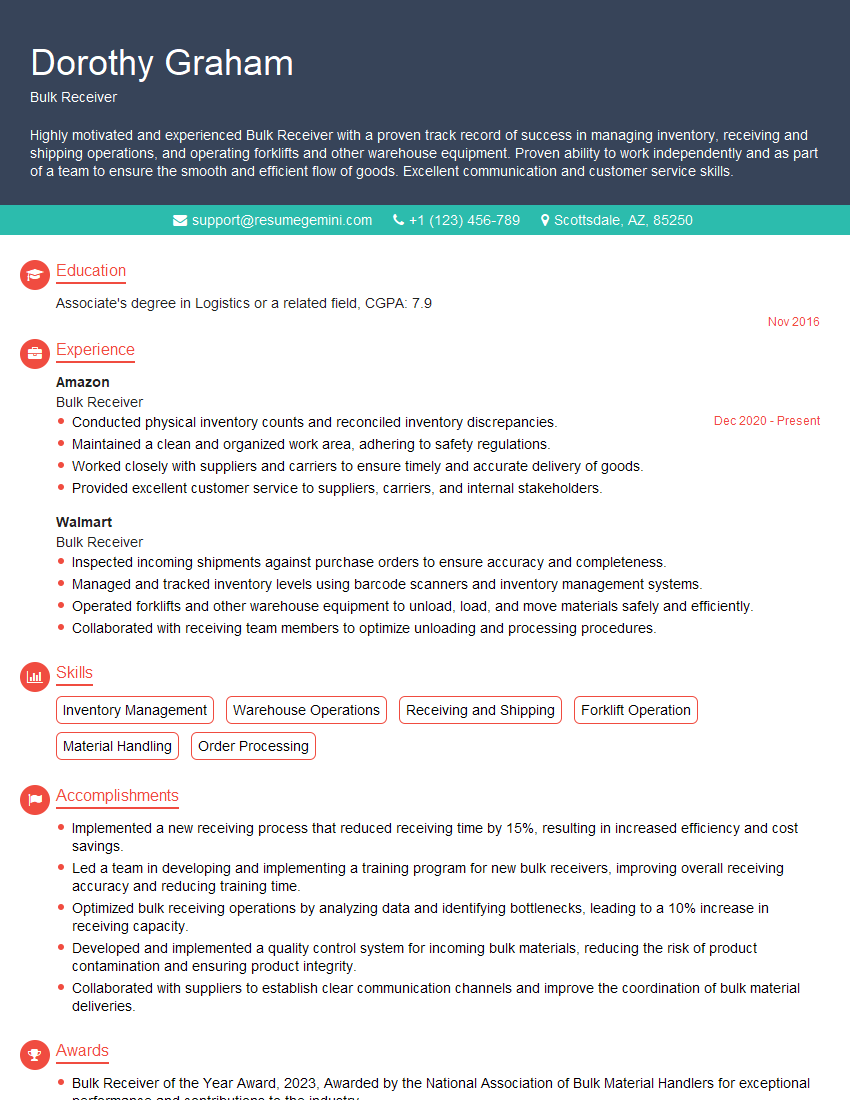
Are you gearing up for a career shift or aiming to ace your next interview? Look no further! We’ve curated a comprehensive guide to help you crack the interview for the coveted Bulk Receiver position. From understanding the key responsibilities to mastering the most commonly asked questions, this blog has you covered. So, buckle up and let’s embark on this journey together.
Acing the interview is crucial, but landing one requires a compelling resume that gets you noticed. Crafting a professional document that highlights your skills and experience is the first step toward interview success. ResumeGemini can help you build a standout resume that gets you called in for that dream job.






Essential Interview Questions For Bulk Receiver
1. Explain the process of bulk receiving goods in detail?
Bulk receiving is the process of receiving a large quantity of goods at once. The process typically involves the following steps:
- Verifying the goods against the packing list or purchase order.
- Inspecting the goods for any damage or defects.
- Weighing or measuring the goods to verify the quantity.
- Storing the goods in the appropriate location.
- Updating the inventory records.
2. What are the different types of bulk receiving methods, and which is the most appropriate for a given situation?
Receiving by weight
- This method is used when the goods are sold by weight, such as grain or sand.
- The goods are weighed on a scale and the weight is recorded.
Receiving by volume
- This method is used when the goods are sold by volume, such as liquids or gases.
- The goods are measured in a container and the volume is recorded.
Receiving by count
- This method is used when the goods are sold by count, such as individual items or packages.
- The goods are counted and the count is recorded.
3. What are the key considerations when receiving bulk goods?
The key considerations when receiving bulk goods include:
- The type of goods being received.
- The quantity of goods being received.
- The condition of the goods being received.
- The storage requirements for the goods.
- The security requirements for the goods.
4. What are the safety precautions that should be taken when receiving bulk goods?
The safety precautions that should be taken when receiving bulk goods include:
- Wearing appropriate personal protective equipment (PPE), such as gloves, safety glasses, and a hard hat.
- Using proper lifting techniques.
- Being aware of the hazards associated with the goods being received, such as flammability or toxicity.
- Following the instructions provided by the supplier.
5. What are the documentation requirements for receiving bulk goods?
The documentation requirements for receiving bulk goods may vary depending on the type of goods being received and the supplier. However, some common documentation requirements include:
- Packing list or purchase order.
- Bill of lading.
- Certificate of analysis.
- Safety data sheet (SDS).
6. What are the recordkeeping requirements for receiving bulk goods?
The recordkeeping requirements for receiving bulk goods may vary depending on the type of goods being received and the supplier. However, some common recordkeeping requirements include:
- Date of receipt.
- Quantity of goods received.
- Condition of the goods received.
- Storage location of the goods.
- Supplier information.
7. What are the quality control procedures that should be followed when receiving bulk goods?
The quality control procedures that should be followed when receiving bulk goods may vary depending on the type of goods being received. However, some common quality control procedures include:
- Verifying the goods against the packing list or purchase order.
- Inspecting the goods for any damage or defects.
- Weighing or measuring the goods to verify the quantity.
- Testing the goods to verify the quality.
8. What are the inventory management techniques that can be used to track bulk goods?
The inventory management techniques that can be used to track bulk goods include:
- First-in, first-out (FIFO).
- Last-in, first-out (LIFO).
- Average cost.
9. What are the security measures that should be taken to protect bulk goods?
The security measures that should be taken to protect bulk goods include:
- Storing the goods in a secure location.
- Limiting access to the goods to authorized personnel.
- Monitoring the goods for any unauthorized activity.
- Following the security procedures provided by the supplier.
10. What are the training requirements for personnel who receive bulk goods?
The training requirements for personnel who receive bulk goods may vary depending on the type of goods being received. However, some common training requirements include:
- The proper handling and storage of the goods.
- The safety precautions that should be taken when receiving the goods.
- The documentation and recordkeeping requirements for receiving the goods.
- The quality control procedures that should be followed when receiving the goods.
- The security measures that should be taken to protect the goods.
Interviewers often ask about specific skills and experiences. With ResumeGemini‘s customizable templates, you can tailor your resume to showcase the skills most relevant to the position, making a powerful first impression. Also check out Resume Template specially tailored for Bulk Receiver.
Career Expert Tips:
- Ace those interviews! Prepare effectively by reviewing the Top 50 Most Common Interview Questions on ResumeGemini.
- Navigate your job search with confidence! Explore a wide range of Career Tips on ResumeGemini. Learn about common challenges and recommendations to overcome them.
- Craft the perfect resume! Master the Art of Resume Writing with ResumeGemini’s guide. Showcase your unique qualifications and achievements effectively.
- Great Savings With New Year Deals and Discounts! In 2025, boost your job search and build your dream resume with ResumeGemini’s ATS optimized templates.
Researching the company and tailoring your answers is essential. Once you have a clear understanding of the Bulk Receiver‘s requirements, you can use ResumeGemini to adjust your resume to perfectly match the job description.
Key Job Responsibilities
Bulk Receivers are responsible for ensuring that the materials received meet the quantity and quality standards of the company.
1. Receiving and Verifying Deliveries
Receive and verify incoming bulk materials shipments.
- Check and document the quantity and quality of the received materials.
- Compare the received materials against the purchase orders and other relevant documents.
2. Inspecting Materials
Inspect the received materials for any damage or defects.
- Identify and report any discrepancies or problems with the received materials.
- Quarantine or reject materials that do not meet the company’s standards.
3. Storing Materials
Properly store the received materials in designated areas.
- Ensure that the materials are stored in a manner that maintains their quality and prevents damage or contamination.
- Maintain inventory records and update them as necessary.
4. Loading and Unloading Materials
Load and unload materials from trucks, rail cars, or other vehicles.
- Operate forklifts and other material handling equipment.
- Follow safety procedures and wear appropriate personal protective equipment.
Interview Tips
Preparing for an interview for a Bulk Receiver position is crucial to showcase your skills and qualifications and impress the interviewer. Here are some tips to help you ace the interview:
1. Research the Company and the Position
Before the interview, take the time to research the company you are applying to and the specific Bulk Receiver position. This will give you a good understanding of the company’s culture, industry, and the responsibilities of the role.
- Visit the company’s website and social media pages.
- Read industry news and articles to stay informed about the latest trends.
2. Practice Answering Common Interview Questions
Prepare for the interview by practicing answering common interview questions. This will help you feel more confident and organized during the interview.
- Questions about your experience and skills
- Questions about your knowledge of the industry
- Questions about your availability and willingness to work overtime or on weekends
3. Emphasize Your Relevant Skills and Experience
During the interview, highlight your relevant skills and experience that make you a suitable candidate for the Bulk Receiver position.
- Quantify your accomplishments using specific numbers and metrics.
- Use examples from your previous work experience to demonstrate your abilities.
4. Ask Insightful Questions
Asking insightful questions at the end of the interview shows that you are engaged and interested in the position. It also gives you an opportunity to clarify any details or concerns you may have.
- Ask about the company’s growth plans and industry outlook.
- Inquire about the specific responsibilities and expectations of the Bulk Receiver role.
Next Step:
Armed with this knowledge, you’re now well-equipped to tackle the Bulk Receiver interview with confidence. Remember, a well-crafted resume is your first impression. Take the time to tailor your resume to highlight your relevant skills and experiences. And don’t forget to practice your answers to common interview questions. With a little preparation, you’ll be on your way to landing your dream job. So what are you waiting for? Start building your resume and start applying! Build an amazing resume with ResumeGemini.