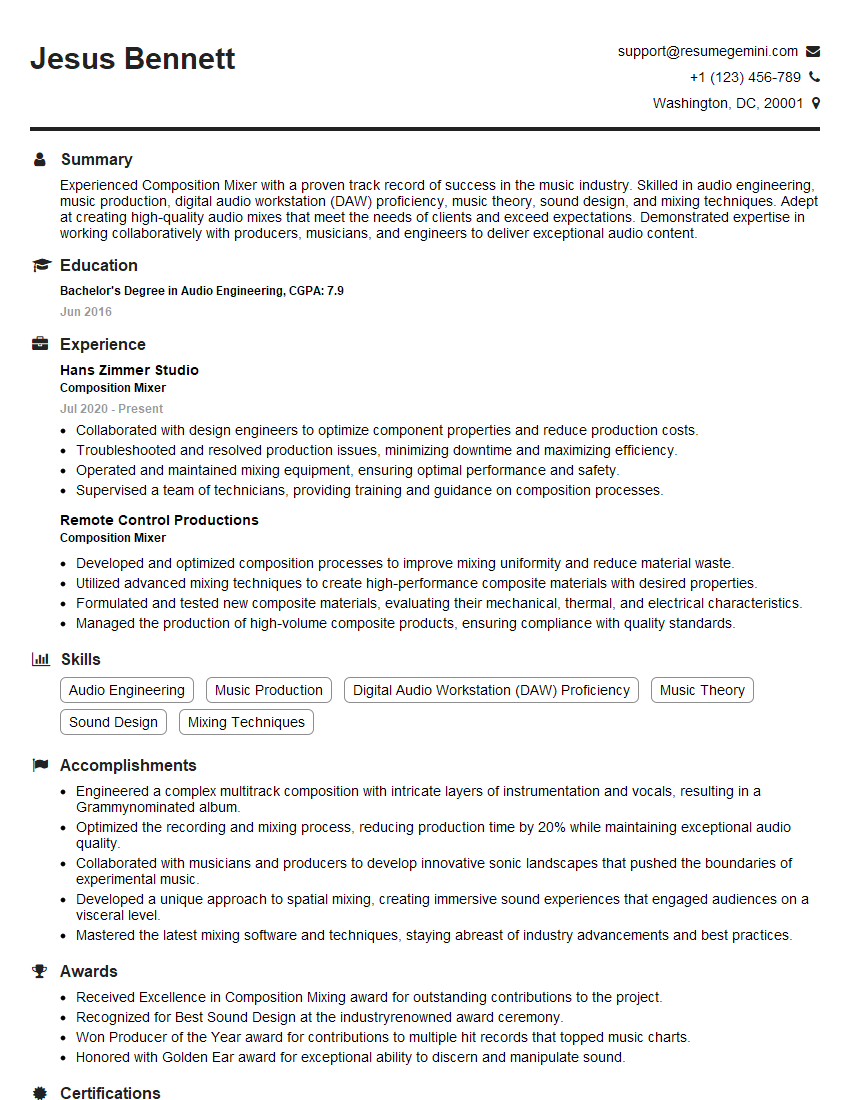
Are you gearing up for an interview for a Composition Mixer position? Whether you’re a seasoned professional or just stepping into the role, understanding what’s expected can make all the difference. In this blog, we dive deep into the essential interview questions for Composition Mixer and break down the key responsibilities of the role. By exploring these insights, you’ll gain a clearer picture of what employers are looking for and how you can stand out. Read on to equip yourself with the knowledge and confidence needed to ace your next interview and land your dream job!
Acing the interview is crucial, but landing one requires a compelling resume that gets you noticed. Crafting a professional document that highlights your skills and experience is the first step toward interview success. ResumeGemini can help you build a standout resume that gets you called in for that dream job.






Essential Interview Questions For Composition Mixer
1. What is Composition Mixing and its Importance?
- Composition Mixing involves blending different musical elements such as vocals, instruments, and electronic sounds to create a cohesive and balanced musical production.
- Its importance lies in enhancing the musicality, clarity, and emotional impact of a composition by optimizing the levels, panning, and effects of each element.
2. Explain the Process of Mixing Vocals
Equalization
- Using EQ to shape the tonal balance of vocals, removing harshness, sibilance, or unwanted resonances.
- Applying dynamic EQ to adjust the EQ curve based on the vocal’s dynamics.
Compression
- Using compression to control the vocal’s dynamic range, reduce peaks, and enhance consistency.
- Employing multiband compression to target specific frequency ranges for more precise control.
3. How do you Approach Mixing a Complex Arrangement with Multiple Instruments?
- Identify the most important elements in the arrangement and focus on their clarity.
- Use panning and stereo imaging to create a wide and immersive soundstage.
- Employ EQ, compression, and other processing techniques to separate and define each instrument.
- Create subgroups for similar instruments and process them collectively for cohesion.
4. Discuss the Role of Automation in Mixing
- Automation allows for dynamic control over parameters such as volume, panning, and effects over time.
- It can be used to enhance transitions, add interest, or correct imbalances.
- Automation can also be applied to create rhythmic effects, such as rhythmic ducking or sidechain compression.
5. How do you Utilize Reference Tracks in Mixing?
- Reference tracks provide a benchmark for comparison and inspiration.
- They can be used to assess the overall balance, EQ profile, or dynamic range of a mix.
- By matching or exceeding the quality of reference tracks, mixers can ensure their mixes are competitive.
6. Explain the Significance of Loudness in Mixing
- Loudness is crucial for commercial success, as listeners tend to prefer louder-sounding compositions.
- However, excessive loudness can lead to distortion and fatigue.
- Mixers must strike a balance between achieving sufficient loudness while maintaining clarity and sonic integrity.
7. How do you Handle Mixing for Different Listening Environments?
- Consider the acoustic characteristics of various listening environments, such as headphones, car stereos, and home systems.
- Use EQ and panning to optimize the mix for each environment.
- Pay attention to the frequency response and dynamic range of the target listening environment.
8. Discuss the Importance of Collaboration with Artists and Producers
- Collaboration is essential for understanding the artist’s vision and translating it into the mix.
- Communication and open dialogue ensure that the mix aligns with the artist’s expectations.
- Producers provide valuable input on arrangement, instrumentation, and production choices.
9. How do you Stay Updated with Mixing Trends and Techniques?
- Attending industry conferences and workshops.
- Subscribing to industry publications and blogs.
- Networking with other mixers and producers.
- Experimenting with new mixing techniques and plugins.
10. What are your Experiences with Mixing in Different Genres?
- Provide examples of projects in various genres, showcasing your versatility and adaptability.
- Describe the unique mixing challenges and techniques employed for each genre.
- Highlight how your understanding of genre conventions has influenced your mixing approach.
Interviewers often ask about specific skills and experiences. With ResumeGemini‘s customizable templates, you can tailor your resume to showcase the skills most relevant to the position, making a powerful first impression. Also check out Resume Template specially tailored for Composition Mixer.
Career Expert Tips:
- Ace those interviews! Prepare effectively by reviewing the Top 50 Most Common Interview Questions on ResumeGemini.
- Navigate your job search with confidence! Explore a wide range of Career Tips on ResumeGemini. Learn about common challenges and recommendations to overcome them.
- Craft the perfect resume! Master the Art of Resume Writing with ResumeGemini’s guide. Showcase your unique qualifications and achievements effectively.
- Great Savings With New Year Deals and Discounts! In 2025, boost your job search and build your dream resume with ResumeGemini’s ATS optimized templates.
Researching the company and tailoring your answers is essential. Once you have a clear understanding of the Composition Mixer‘s requirements, you can use ResumeGemini to adjust your resume to perfectly match the job description.
Key Job Responsibilities
Composition Mixers are an essential part of various industries, including chemical, cosmetics, and food manufacturing. They are accountable for formulating and blending a wide range of ingredients to create products that meet specific requirements and standards.
1. Formulation Development
Composition Mixers play a pivotal role in developing and improving formulations. They analyze existing compositions, identify areas for optimization, and conduct thorough research to determine the most suitable ingredients and their ideal proportions.
- Analyze market trends and customer feedback to identify new product opportunities and areas for improvement.
- Identify and qualify new ingredients, evaluating their compatibility and potential benefits.
2. Ingredient Blending and Mixing
Composition Mixers are responsible for the blending and mixing of ingredients according to prescribed formulas. They skillfully operate mixing equipment, ensuring proper dispersion and homogenization of components.
- Precisely follow formulation specifications and maintain consistent mixing parameters to achieve desired product properties.
- Monitor mixing processes closely and make adjustments as needed to optimize blending efficiency.
3. Quality Control and Assurance
Composition Mixers play a crucial role in maintaining product quality and safety. They conduct in-process evaluations and final inspections to ensure that products meet established standards.
- Perform routine testing and analysis of ingredients and finished products to verify compliance with specifications.
- Maintain accurate and detailed records of all mixing operations and quality control procedures.
4. Equipment Maintenance and Calibration
Composition Mixers are responsible for the upkeep and calibration of mixing equipment. They conduct regular inspections and preventive maintenance to ensure optimal performance.
- Identify and resolve any equipment issues promptly to minimize downtime and maintain production efficiency.
- Collaborate with maintenance technicians for major repairs and upgrades.
Interview Preparation Tips
Interview Preparation is essential to ace any job interview. Here are some useful tips for a Composition Mixer interview:
1. Research the Company and Position
Prior to the interview, take the time to thoroughly research the company and the specific position you are applying for. This will demonstrate your genuine interest and understanding of their business.
- Visit the company’s website, read about their history, mission, and products.
- Review the job description thoroughly to gain insights into the key responsibilities and qualifications.
2. Practice Your Answers
Take the time to anticipate and prepare answers to common interview questions. Practice your responses in front of a mirror or with a friend to build confidence and ensure clarity.
- Prepare examples that highlight your skills and experience in formulation development, blending, quality control, and equipment maintenance.
- Consider potential questions about your knowledge of industry standards and regulatory compliance.
3. Highlight Relevant Skills and Experience
During the interview, emphasize your relevant skills and experience that align with the position’s requirements. Quantify your accomplishments whenever possible to showcase your impact.
- Share examples of successful formulations you have developed, highlighting your ability to optimize product properties.
- Discuss your experience in implementing quality control procedures and ensuring compliance with industry regulations.
4. Prepare Questions for the Interviewer
Preparing thoughtful questions demonstrates your engagement and interest in the position. It also provides an opportunity to gather additional information about the role and the company.
- Ask about the company’s product development pipeline and their plans for future growth.
- Inquire about the training and development opportunities available for employees.
5. Follow Up
After the interview, send a thank-you note to the interviewer within 24 hours. This gesture expresses your appreciation and reaffirms your interest in the position.
- Reiterate your key qualifications and how they align with the company’s needs.
- Express your enthusiasm for the opportunity and indicate your continued interest.
Next Step:
Armed with this knowledge, you’re now well-equipped to tackle the Composition Mixer interview with confidence. Remember, a well-crafted resume is your first impression. Take the time to tailor your resume to highlight your relevant skills and experiences. And don’t forget to practice your answers to common interview questions. With a little preparation, you’ll be on your way to landing your dream job. So what are you waiting for? Start building your resume and start applying! Build an amazing resume with ResumeGemini.