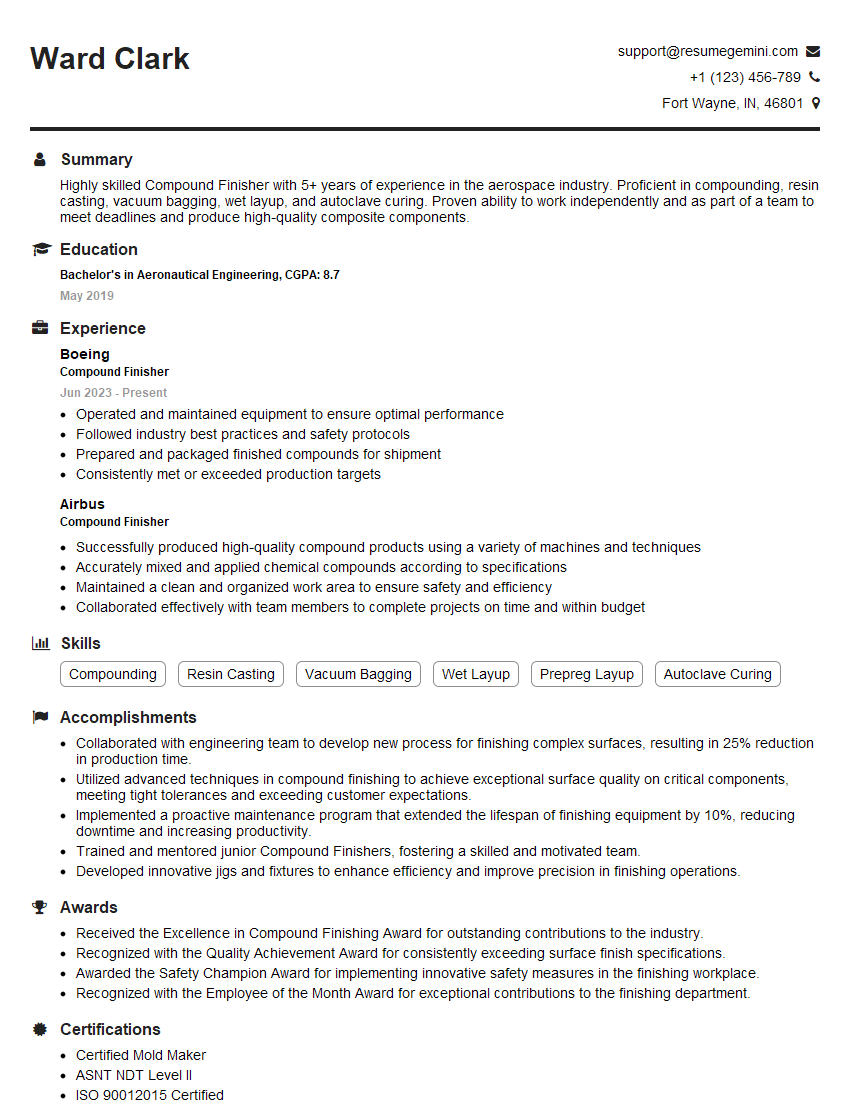
Feeling lost in a sea of interview questions? Landed that dream interview for Compound Finisher but worried you might not have the answers? You’re not alone! This blog is your guide for interview success. We’ll break down the most common Compound Finisher interview questions, providing insightful answers and tips to leave a lasting impression. Plus, we’ll delve into the key responsibilities of this exciting role, so you can walk into your interview feeling confident and prepared.
Acing the interview is crucial, but landing one requires a compelling resume that gets you noticed. Crafting a professional document that highlights your skills and experience is the first step toward interview success. ResumeGemini can help you build a standout resume that gets you called in for that dream job.






Essential Interview Questions For Compound Finisher
1. What are the different types of compounds used in finishing?
In the finishing process, various types of compounds are utilized to achieve specific effects on the surface. Some of the most commonly used compounds include:
- Cutting compounds: Designed to remove scratches and imperfections from the surface.
- Polishing compounds: Used to refine the surface and bring out its gloss.
- Waxes and sealants: Applied to protect the finished surface and enhance its durability.
2. What factors influence the selection of the appropriate compound?
Surface material
- The type of surface being finished, such as metal, plastic, or wood, determines the compound’s composition.
Desired finish
- The desired level of gloss and smoothness influences the choice of compound.
Equipment capabilities
- The type of equipment used, such as orbital buffers or rotary polishers, affects the compound’s formulation.
3. Describe the steps involved in the compound finishing process.
The compound finishing process generally involves the following steps:
- Surface preparation: Cleaning and degreasing the surface to ensure proper adhesion.
- Compound application: Applying the appropriate compound to the surface using a buffer pad.
- Compounding: Using a buffer or polisher to work the compound into the surface.
- Removal: Wiping away the compound residue using a clean cloth.
- Inspection: Checking the surface for smoothness and gloss.
4. How do you determine the correct pressure to apply during compounding?
The appropriate pressure to apply during compounding depends on several factors:
- Surface material: Softer materials require less pressure than harder materials.
- Compound formulation: Different compounds may have varying pressure requirements.
- Equipment used: The type of buffer or polisher affects the amount of pressure needed.
- Desired finish: Higher pressure can result in a more aggressive cut, while lower pressure yields a finer finish.
5. What are some common mistakes to avoid during compound finishing?
To ensure optimal results and prevent damage to the surface, some common mistakes to avoid during compound finishing include:
- Using too much pressure: Excessive pressure can damage the surface and create swirls.
- Overworking the compound: Leaving the compound on the surface for too long can lead to discoloration.
- Using the wrong compound: Choosing an inappropriate compound for the surface material or desired finish can result in unsatisfactory outcomes.
- Skipping surface preparation: Failure to properly clean and degrease the surface can compromise adhesion and lead to premature failure.
6. What are the safety precautions to consider when using compounds?
To ensure safety when using compounds, it is crucial to follow these precautions:
- Wear appropriate protective gear: Gloves, eye protection, and a respirator to prevent inhalation of fumes.
- Use in a well-ventilated area: Compounds can release harmful vapors, so proper ventilation is essential.
- Handle compounds carefully: Avoid skin contact and ingestion, as they may contain hazardous chemicals.
- Store compounds properly: Keep compounds in a cool, dry place and away from direct sunlight.
7. How do you maintain and clean your equipment after compound finishing?
Maintaining and cleaning equipment after compound finishing is vital to ensure its longevity and effectiveness:
- Clean buffer pads: Wash the pads thoroughly with soap and water to remove any residual compound.
- Clean the buffer or polisher: Wipe down the machine with a damp cloth to remove any dust or debris.
- Lubricate the buffer or polisher: As per the manufacturer’s instructions, lubricate the machine’s moving parts to maintain smooth operation.
- Store equipment properly: Keep the equipment in a dry and clean place when not in use.
8. What techniques can you use to achieve a mirror finish on a surface?
To achieve a mirror finish on a surface, the following techniques can be employed:
- Use a fine-grit compound: Progressively use finer grades of compound to remove finer scratches and imperfections.
- Apply the compound evenly: Use a buffer pad to distribute the compound uniformly over the surface.
- Work the compound slowly and carefully: Avoid applying too much pressure or overworking the compound.
- Remove the compound thoroughly: Use a clean microfiber cloth to wipe away any residue completely.
- Inspect the surface regularly: Check the surface for any remaining scratches or imperfections and repeat the process as necessary.
9. How do you troubleshoot common problems encountered during compound finishing?
To resolve common problems in compound finishing, consider the following troubleshooting tips:
- Surface damage: If the surface is damaged during compounding, it may require sanding or repainting to repair the damage.
- Swirls or holograms: These are caused by improper compounding technique or using the wrong compound; try using a finer compound and applying less pressure.
- Discoloration: If the surface is discolored, it may indicate that the compound was left on for too long; remove the compound immediately and start over.
- Poor adhesion: Ensure the surface is properly prepared and free of any contaminants before compounding.
10. What are the latest advancements in compound finishing technology?
The compound finishing industry is constantly evolving, and recent advancements include:
- Nano-abrasive compounds: These compounds use extremely fine abrasives to achieve a high level of surface refinement.
- Compound applicator machines: Automated machines can precisely apply and remove compounds, reducing the risk of human error.
- Environmentally friendly compounds: Compounds with reduced VOC emissions and biodegradable formulations are becoming more prevalent.
- Robotic polishing systems: Robots are being used for precise and efficient polishing operations.
Interviewers often ask about specific skills and experiences. With ResumeGemini‘s customizable templates, you can tailor your resume to showcase the skills most relevant to the position, making a powerful first impression. Also check out Resume Template specially tailored for Compound Finisher.
Career Expert Tips:
- Ace those interviews! Prepare effectively by reviewing the Top 50 Most Common Interview Questions on ResumeGemini.
- Navigate your job search with confidence! Explore a wide range of Career Tips on ResumeGemini. Learn about common challenges and recommendations to overcome them.
- Craft the perfect resume! Master the Art of Resume Writing with ResumeGemini’s guide. Showcase your unique qualifications and achievements effectively.
- Great Savings With New Year Deals and Discounts! In 2025, boost your job search and build your dream resume with ResumeGemini’s ATS optimized templates.
Researching the company and tailoring your answers is essential. Once you have a clear understanding of the Compound Finisher‘s requirements, you can use ResumeGemini to adjust your resume to perfectly match the job description.
Key Job Responsibilities
A Compound Finisher holds a key role in maintaining the quality and efficiency of pharmaceutical production. Their primary responsibility lies in the final stages of compounding, where they ensure the accurate dispensing and packaging of medications.
1. Preparation and Dispensing of Medications
Compound Finishers are responsible for the precise preparation and dispensing of medications according to prescriptions and established protocols. They meticulously weigh, measure, and mix various ingredients to create customized medications for patients.
- Calculate and weigh ingredients accurately using scales and measuring devices.
- Prepare and mix medications, including ointments, creams, suspensions, and capsules.
- Dispense medications into appropriate containers, such as vials, bottles, or blister packs.
2. Packaging and Labeling
Compound Finishers play a crucial role in ensuring the safe and proper packaging of medications. They label and package medications according to regulations, providing patients with clear instructions on dosage, storage, and administration.
- Label medications with patient information, medication name, dosage instructions, and expiration dates.
- Package medications in tamper-proof containers and provide appropriate storage instructions.
- Maintain a clean and organized work area to prevent contamination or errors.
3. Quality Control and Documentation
To ensure patient safety and regulatory compliance, Compound Finishers adhere to strict quality control measures. They perform checks and inspections throughout the compounding process, maintain accurate records, and report any discrepancies or errors.
- Perform visual inspections of medications for quality and accuracy.
- Document all steps of the compounding process, including ingredients used, quantities, and dispensing details.
- Report any deviations from standard procedures or identified errors to supervisors or quality control personnel.
4. Collaboration and Communication
Compound Finishers work collaboratively with other healthcare professionals, including pharmacists, nurses, and physicians. They communicate effectively to ensure the accurate and timely dispensing of medications and to resolve any issues that may arise.
- Collaborate with pharmacists to prepare and dispense complex or specialized medications.
- Communicate with nurses and physicians to clarify prescription orders or address patient concerns.
- Participate in training and continuing education programs to stay updated on industry regulations and best practices.
Interview Tips
To ace an interview for a Compound Finisher position, preparation is key. Here are some tips and hacks to help you stand out:
1. Research the Organization and Industry
Take the time to familiarize yourself with the organization you’re applying to, its mission, values, and products or services. Additionally, research the pharmaceutical industry, current trends, and regulations to demonstrate your knowledge and interest.
- Visit the company’s website and read its annual reports or press releases.
- Stay updated on industry news and regulatory changes by following relevant publications or attending webinars.
2. Practice Your Skills and Prepare Examples
Make sure you can clearly articulate your skills and experience as a Compound Finisher. Practice answering common interview questions related to your ability to accurately prepare and dispense medications, maintain quality control, and communicate effectively.
- Describe a specific instance where you successfully resolved a medication error or discrepancy.
- Explain how you ensure the accuracy and quality of medications during the compounding process.
3. Highlight Your Attention to Detail and Accuracy
Emphasize your meticulous attention to detail and ability to work accurately. Compound Finishers play a critical role in ensuring patient safety, so highlight your commitment to precision and adherence to protocols.
- Mention any certifications or training you have in quality control or pharmaceutical compounding.
- Provide examples of how you have consistently met or exceeded accuracy targets in previous roles.
4. Demonstrate Your Teamwork and Communication Skills
Explain how you collaborate effectively with other healthcare professionals, such as pharmacists and nurses. Highlight your ability to communicate clearly and resolve issues or concerns.
- Share examples of how you have successfully resolved patient queries or concerns about their medications.
- Describe your experience working in a team environment and how you contribute to its success.
Next Step:
Armed with this knowledge, you’re now well-equipped to tackle the Compound Finisher interview with confidence. Remember, preparation is key. So, start crafting your resume, highlighting your relevant skills and experiences. Don’t be afraid to tailor your application to each specific job posting. With the right approach and a bit of practice, you’ll be well on your way to landing your dream job. Build your resume now from scratch or optimize your existing resume with ResumeGemini. Wish you luck in your career journey!