Are you gearing up for a career in Drilling Machine Runner? Feeling nervous about the interview questions that might come your way? Don’t worry, you’re in the right place. In this blog post, we’ll dive deep into the most common interview questions for Drilling Machine Runner and provide you with expert-backed answers. We’ll also explore the key responsibilities of this role so you can tailor your responses to showcase your perfect fit.
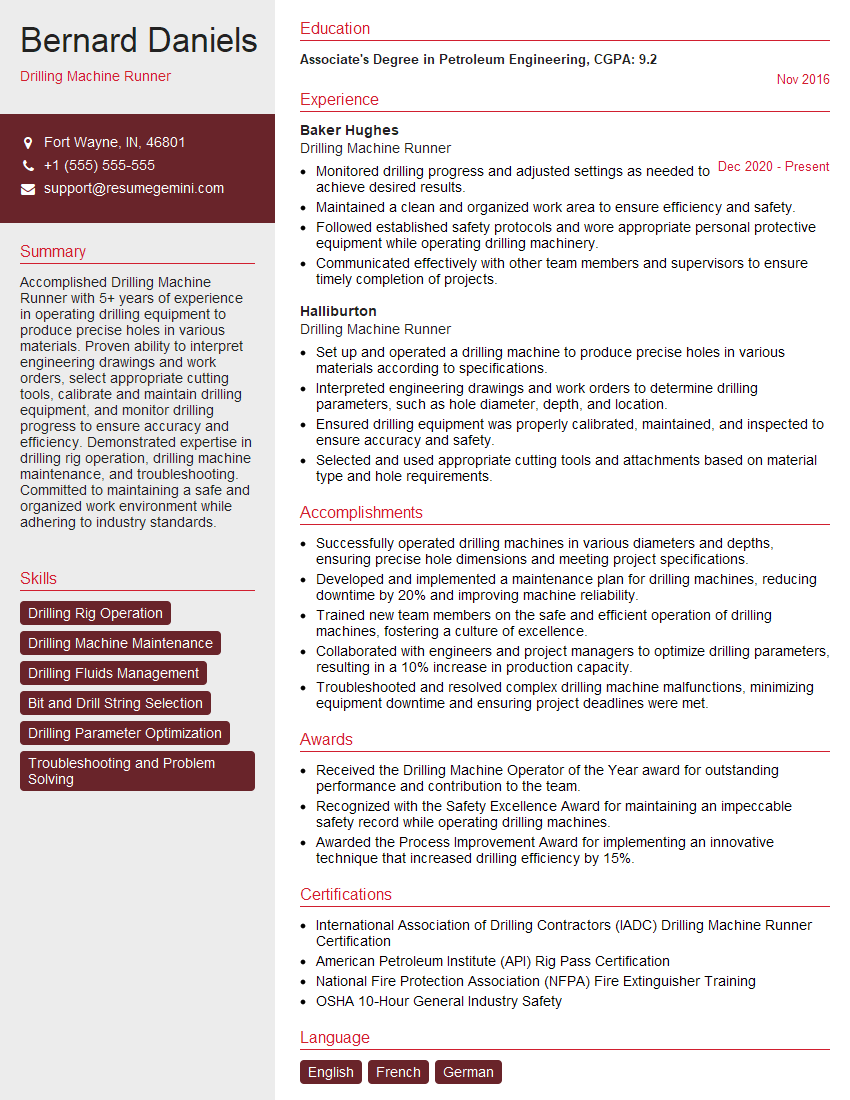
Acing the interview is crucial, but landing one requires a compelling resume that gets you noticed. Crafting a professional document that highlights your skills and experience is the first step toward interview success. ResumeGemini can help you build a standout resume that gets you called in for that dream job.






Essential Interview Questions For Drilling Machine Runner
1. What are the different types of drilling machines and their applications?
- Radial Drilling Machine: Used for drilling holes in large workpieces, can move in multiple directions.
- Upright Drilling Machine: Commonly used in workshops, suitable for drilling holes in smaller workpieces.
- Horizontal Drilling Machine: Designed for drilling holes in large and heavy workpieces, such as those used in shipbuilding.
- Gang Drilling Machine: Has multiple spindles that can drill multiple holes simultaneously, ideal for mass production.
- CNC Drilling Machine: Computer-controlled drilling machine that offers high precision and repeatability.
2. Describe the process of setting up and operating a drilling machine.
Preparing the Machine
- Ensure the machine is properly grounded for safety.
- Mount the workpiece securely on the work table.
- Lubricate the drill bit as per manufacturer’s instructions.
Operating the Machine
- Set the appropriate feed rate and spindle speed for the drill bit and workpiece material.
- Position the drill bit over the workpiece and start the machine.
- Gradually lower the drill bit into the workpiece, applying slight downward pressure.
- Monitor the progress of the drilling process and adjust parameters as needed.
- Once the desired depth is reached, retract the drill bit and stop the machine.
3. How do you select the appropriate drill bit for a particular drilling operation?
- Consider the workpiece material and its hardness.
- Determine the desired hole size and depth.
- Choose the appropriate drill bit type (e.g., twist drill, spade drill, hole saw).
- Select the correct drill bit size for the desired hole diameter.
- Check the shank type to ensure compatibility with the drilling machine.
4. How do you maintain and troubleshoot a drilling machine?
Maintenance
- Regularly clean and lubricate the machine components.
- Inspect the drill bits for wear and replace them when necessary.
- Check the spindle bearings and belt tension.
- Follow the manufacturer’s recommended maintenance schedule.
Troubleshooting
- Drill bit breakage: Check for dull or damaged drill bits, improper feed rate, or excessive workpiece hardness.
- Poor hole quality: Adjust feed rate, spindle speed, or cutting fluid to optimize performance.
- Machine vibration: Ensure the workpiece is securely clamped, check for unbalanced or damaged components, and calibrate the machine.
5. How do you ensure precision and accuracy while drilling holes?
- Use a sharp and properly sharpened drill bit.
- Set the appropriate feed rate and spindle speed for the workpiece material.
- Use a drill guide or template to ensure straight and precise holes.
- Apply cutting fluid to reduce friction and improve hole quality.
- Check the alignment of the drill press table and spindle before drilling.
6. What safety precautions should be taken while operating a drilling machine?
- Wear appropriate safety gear, including safety glasses, gloves, and hearing protection.
- Ensure the machine is properly grounded and the workpiece is securely fastened.
- Keep hands and clothing away from rotating parts.
- Use a chuck key or wrench to tighten and loosen the drill bit.
- Never leave the machine unattended while it is running.
7. How do you inspect and measure the quality of drilled holes?
- Visually examine the holes for any irregularities, such as burrs or uneven surfaces.
- Use a hole gauge or caliper to measure the diameter and depth of the holes.
- Check the hole for roundness and straightness using a dial indicator or straightedge.
- Compare the results to the specified tolerances.
8. What are the different types of cutting fluids used in drilling and their advantages?
- Oil-based cutting fluids: Provide good lubrication and cooling, but can be messy and difficult to clean.
- Water-based cutting fluids: Environmentally friendly and easy to clean, but may not provide as good lubrication as oil-based.
- Synthetic cutting fluids: Offer a balance of lubrication, cooling, and ease of cleaning.
- Solid cutting fluids: Used in specialized applications, such as drilling hard metals.
9. How do you calculate the machining time for a drilling operation?
- Determine the feed rate (inches per minute) of the drill bit.
- Measure the depth of the hole (inches).
- Apply the formula: Machining Time = (Depth of Hole / Feed Rate) + (Retraction Time + Other Time Allowances)
- Retraction Time and Other Time Allowances are typically estimated based on experience and knowledge of the machine.
10. What are the quality control procedures for drilling operations?
- Establish and maintain inspection plans for drilled holes.
- Use calibrated measuring instruments to verify hole size, depth, and accuracy.
- Conduct regular inspections and audits to ensure adherence to quality standards.
- Implement corrective actions when necessary to improve the quality of drilling operations.
Interviewers often ask about specific skills and experiences. With ResumeGemini‘s customizable templates, you can tailor your resume to showcase the skills most relevant to the position, making a powerful first impression. Also check out Resume Template specially tailored for Drilling Machine Runner.
Career Expert Tips:
- Ace those interviews! Prepare effectively by reviewing the Top 50 Most Common Interview Questions on ResumeGemini.
- Navigate your job search with confidence! Explore a wide range of Career Tips on ResumeGemini. Learn about common challenges and recommendations to overcome them.
- Craft the perfect resume! Master the Art of Resume Writing with ResumeGemini’s guide. Showcase your unique qualifications and achievements effectively.
- Great Savings With New Year Deals and Discounts! In 2025, boost your job search and build your dream resume with ResumeGemini’s ATS optimized templates.
Researching the company and tailoring your answers is essential. Once you have a clear understanding of the Drilling Machine Runner‘s requirements, you can use ResumeGemini to adjust your resume to perfectly match the job description.
Key Job Responsibilities
A Drilling Machine Runner is responsible for the operation, maintenance, and repair of drilling machines. They work in various industries, including manufacturing, construction, and mining. The key job responsibilities of a Drilling Machine Runner include:
1. Operating drilling machines
Drilling Machine Runners are responsible for operating drilling machines to create holes in various materials, such as metal, wood, and plastic. They must be able to operate the machine safely and efficiently, and they must be able to produce holes that meet the required specifications.
2. Maintaining drilling machines
Drilling Machine Runners are responsible for maintaining drilling machines in good working order. They must be able to identify and repair any problems with the machine, and they must be able to keep the machine clean and lubricated.
3. Repairing drilling machines
Drilling Machine Runners are responsible for repairing drilling machines that have broken down. They must be able to diagnose the problem with the machine, and they must be able to repair the machine quickly and efficiently.
4. Inspecting drilling machines
Drilling Machine Runners are responsible for inspecting drilling machines regularly to ensure that they are safe to operate. They must be able to identify any potential hazards, and they must be able to take steps to eliminate those hazards.
Interview Tips
To ace an interview for a Drilling Machine Runner position, it is important to be prepared. Here are some tips to help you prepare for your interview:
1. Research the company
Before your interview, take some time to research the company. This will help you understand the company’s culture and values, and it will also help you answer questions about why you are interested in working for the company.
2. Practice answering common interview questions
There are a number of common interview questions that you are likely to be asked. Practice answering these questions in advance so that you can deliver your answers confidently and concisely.
3. Prepare questions to ask the interviewer
Asking questions at the end of an interview shows that you are engaged and that you are interested in the position. Prepare a few questions to ask the interviewer about the company, the position, and the team.
4. Dress appropriately
First impressions matter, so dress appropriately for your interview. You want to look professional and put-together, but you also want to be comfortable. Avoid wearing clothing that is too revealing or too casual.
5. Be yourself
The most important thing is to be yourself. The interviewer wants to get to know the real you, so don’t try to be someone you’re not. Just relax and be yourself, and you’ll be sure to make a great impression.
Next Step:
Armed with this knowledge, you’re now well-equipped to tackle the Drilling Machine Runner interview with confidence. Remember, preparation is key. So, start crafting your resume, highlighting your relevant skills and experiences. Don’t be afraid to tailor your application to each specific job posting. With the right approach and a bit of practice, you’ll be well on your way to landing your dream job. Build your resume now from scratch or optimize your existing resume with ResumeGemini. Wish you luck in your career journey!