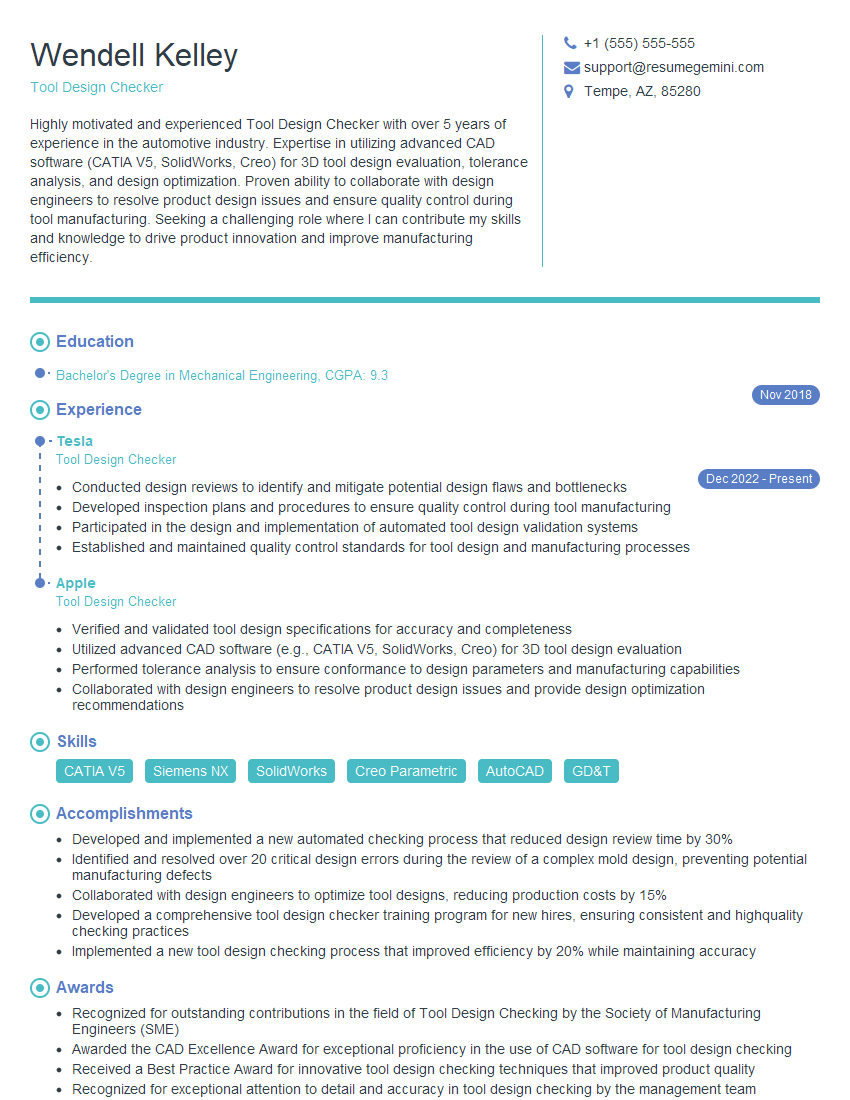
Are you gearing up for a career shift or aiming to ace your next interview? Look no further! We’ve curated a comprehensive guide to help you crack the interview for the coveted Tool Design Checker position. From understanding the key responsibilities to mastering the most commonly asked questions, this blog has you covered. So, buckle up and let’s embark on this journey together
Acing the interview is crucial, but landing one requires a compelling resume that gets you noticed. Crafting a professional document that highlights your skills and experience is the first step toward interview success. ResumeGemini can help you build a standout resume that gets you called in for that dream job.






Essential Interview Questions For Tool Design Checker
1. Explain the key responsibilities of a Tool Design Checker?
As a Tool Design Checker, I would be responsible for:
- Verifying tool designs against customer requirements and engineering specifications
- Identifying and resolving discrepancies or errors in tool designs
- Ensuring that tool designs meet safety and regulatory standards
- Communicating with engineers and designers to clarify design intent and ensure proper execution
- Documenting design reviews and approvals
2. Describe the different types of checks you perform as a Tool Design Checker?
Dimensional Checks
- Verifying that the dimensions of the tool meet the specified tolerances
- Checking for interference between different components of the tool
- Ensuring that the tool can be assembled and disassembled correctly
Material Checks
- Verifying that the materials used in the tool meet the specified requirements
- Checking for compatibility between different materials
- Ensuring that the tool can withstand the intended operating conditions
Functional Checks
- Verifying that the tool can perform its intended function
- Checking for proper operation of all moving parts
- Ensuring that the tool meets the specified performance requirements
3. What are the different software tools you use as a Tool Design Checker?
- Computer-aided design (CAD) software
- Finite element analysis (FEA) software
- Metrology software
- Statistical process control (SPC) software
4. What are the key skills and qualifications required for a Tool Design Checker?
- Strong understanding of mechanical engineering principles
- Proficient in CAD software
- Experience in FEA and metrology
- Excellent communication and interpersonal skills
- Ability to work independently and as part of a team
5. Describe your experience in working with cross-functional teams?
In my previous role, I worked closely with a cross-functional team of engineers, designers, and quality control personnel to develop and launch a new product. I was responsible for ensuring that the tool design met the requirements of all stakeholders and that it could be manufactured and assembled efficiently.
6. What is your approach to identifying and resolving design errors?
- I first review the design carefully to identify any potential errors.
- I then consult with the engineers and designers to clarify the design intent.
- If I find any errors, I work with the team to develop and implement a solution.
- I document all errors and resolutions in the design review report.
7. Describe your experience in using FEA to analyze tool designs?
I have used FEA to analyze the structural integrity of a variety of tool designs. This has helped me to identify potential failure points and to make design modifications to improve the tool’s performance.
8. What is your understanding of the role of SPC in the tool design process?
SPC is a statistical process that helps to ensure that the tool design meets the specified requirements. I use SPC to monitor the production process and to identify any areas where the process is not under control. This information can then be used to make adjustments to the process and to improve the quality of the tool.
9. Describe your experience in working with suppliers to ensure that the tools meet the specified requirements?
In my previous role, I worked closely with suppliers to ensure that the tools met the specified requirements. I visited supplier facilities to review their manufacturing processes and to inspect the tools before they were shipped. I also worked with suppliers to develop and implement quality control procedures.
10. What is your understanding of the importance of documentation in the tool design process?
Documentation is essential in the tool design process. It provides a record of the design intent, the design process, and the design decisions that were made. This documentation can be used to troubleshoot problems, to make modifications to the design, and to train new employees. I am committed to maintaining accurate and up-to-date documentation throughout the tool design process.
Interviewers often ask about specific skills and experiences. With ResumeGemini‘s customizable templates, you can tailor your resume to showcase the skills most relevant to the position, making a powerful first impression. Also check out Resume Template specially tailored for Tool Design Checker.
Career Expert Tips:
- Ace those interviews! Prepare effectively by reviewing the Top 50 Most Common Interview Questions on ResumeGemini.
- Navigate your job search with confidence! Explore a wide range of Career Tips on ResumeGemini. Learn about common challenges and recommendations to overcome them.
- Craft the perfect resume! Master the Art of Resume Writing with ResumeGemini’s guide. Showcase your unique qualifications and achievements effectively.
- Great Savings With New Year Deals and Discounts! In 2025, boost your job search and build your dream resume with ResumeGemini’s ATS optimized templates.
Researching the company and tailoring your answers is essential. Once you have a clear understanding of the Tool Design Checker‘s requirements, you can use ResumeGemini to adjust your resume to perfectly match the job description.
Key Job Responsibilities
Tool Design Checker is accountable for the design and development of tools ensuring they are in sync with the specified design requirements.
1. Evaluate and Verify Design Concepts
Critique designs for manufacturability, serviceability, safety, and cost-effectiveness.
2. Review Tool Design Documentation
Inspect and analyze tool drawings, specifications, and BOMs for correctness and completeness.
3. Conduct Design Verification
Execute simulations, analyses, and calculations to validate tool performance and adherence to standards.
4. Collaboration and Communication
Interact with engineers, designers, and manufacturing teams to address design issues, provide feedback, and ensure design alignment.
Interview Tips
Interview preparation is crucial for a successful outcome. Here are some tips to help you ace your Tool Design Checker interview:
1. Research the Company and Position
Familiarize yourself with the company’s business, culture, and the specific role you’re applying for. This will demonstrate your interest and preparedness.
2. Practice Answering Common Interview Questions
Anticipate questions about your experience, skills, and why you’re interested in the position. Prepare succinct and tailored answers that highlight your relevant qualifications.
3. Showcase Your Tool Design Expertise
Emphasize your proficiency in tool design principles, software applications, and industry standards. Provide specific examples of your successful design projects.
4. Highlight Your Analytical and Problem-Solving Skills
Describe your ability to analyze complex designs, identify errors, and propose effective solutions. Share examples of your troubleshooting and optimization efforts.
Next Step:
Armed with this knowledge, you’re now well-equipped to tackle the Tool Design Checker interview with confidence. Remember, preparation is key. So, start crafting your resume, highlighting your relevant skills and experiences. Don’t be afraid to tailor your application to each specific job posting. With the right approach and a bit of practice, you’ll be well on your way to landing your dream job. Build your resume now from scratch or optimize your existing resume with ResumeGemini. Wish you luck in your career journey!