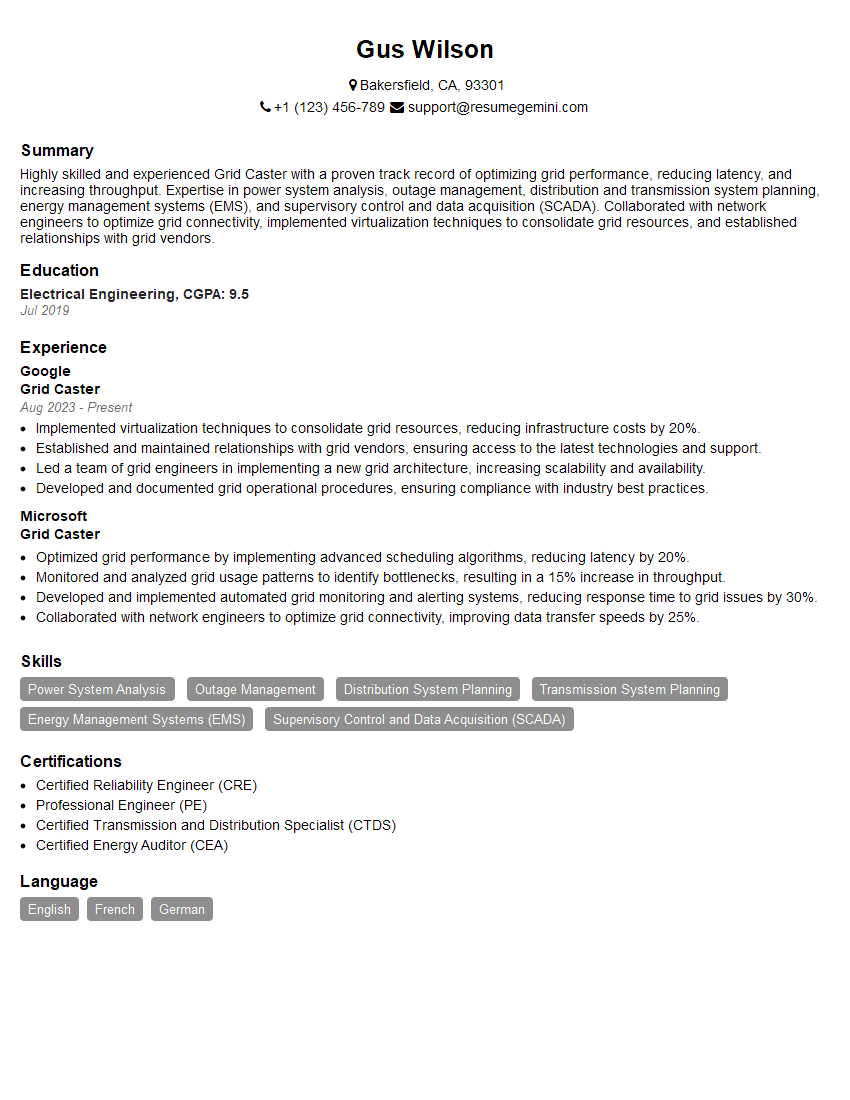
Are you gearing up for a career shift or aiming to ace your next interview? Look no further! We’ve curated a comprehensive guide to help you crack the interview for the coveted Grid Caster position. From understanding the key responsibilities to mastering the most commonly asked questions, this blog has you covered. So, buckle up and let’s embark on this journey together
Acing the interview is crucial, but landing one requires a compelling resume that gets you noticed. Crafting a professional document that highlights your skills and experience is the first step toward interview success. ResumeGemini can help you build a standout resume that gets you called in for that dream job.






Essential Interview Questions For Grid Caster
1. What is Grid Caster and how it is different from other casting methods?
- Grid Caster is a revolutionary casting method that uses a unique mold design to create high-quality castings with precise dimensions and exceptional surface finish.
- Unlike traditional casting methods, Grid Caster utilizes a grid-like mold structure that allows molten metal to flow evenly and fill all areas of the mold, resulting in castings with minimal porosity and defects.
- The grid design also promotes directional solidification, leading to improved mechanical properties and reduced residual stresses in the castings.
2. Explain the process of Grid Casting in detail.
2.1 Mold preparation
- The mold is created using a combination of 3D printing and traditional machining techniques.
- The mold consists of two halves with a grid-like structure, creating a network of channels for molten metal flow.
2.2 Casting
- Molten metal is poured into the mold through a central sprue.
- The grid structure ensures even metal distribution, eliminating turbulence and reducing casting defects.
2.3 Solidification
- The grid design promotes directional solidification, with the metal solidifying from the center outwards.
- This controlled solidification process minimizes shrinkage cavities and produces castings with improved mechanical properties.
2.4 Post-processing
- After solidification, the mold is opened, and the casting is removed.
- Minimal post-processing is required, such as trimming and heat treatment if necessary.
3. What are the advantages of using Grid Casting over other casting methods?
- Improved casting quality with reduced porosity and defects.
- Precise dimensions and exceptional surface finish, reducing the need for machining.
- Enhanced mechanical properties due to directional solidification.
- Faster production times due to simplified mold design and reduced post-processing.
- Cost-effective for producing complex castings with high precision.
4. Can you provide examples of applications where Grid Casting is particularly beneficial?
- Aerospace components requiring high precision and lightweight.
- Medical implants and devices where biocompatibility and dimensional accuracy are crucial.
- Automotive parts for weight reduction and improved performance.
- Electronic enclosures where thermal management and EMI shielding are important.
- Complex architectural elements with intricate details.
5. What are the limitations or considerations when using Grid Casting?
- The mold design process requires specialized software and expertise.
- The grid structure can limit the production of certain geometries.
- Large castings may require multiple molds or a larger grid design, increasing the overall size of the mold.
- The casting process may require higher pressure or centrifugal force to ensure proper metal flow.
6. How do you ensure the quality and consistency of Grid Castings?
- Rigorous quality control measures throughout the process.
- Validation of mold designs using simulation software.
- Inspection of castings using advanced non-destructive testing techniques.
- Regular calibration of equipment and adherence to established process parameters.
7. What is the potential for further development and innovation in Grid Casting technology?
- Optimization of grid design algorithms for improved casting yield.
- Integration of advanced materials and coatings to enhance casting properties.
- Development of automated systems for mold preparation and casting.
- Exploration of new applications in emerging industries.
8. How can Grid Casting contribute to the overall efficiency and sustainability of the manufacturing industry?
- Reduced material waste due to precision casting.
- Energy savings through optimized casting processes.
- Improved product quality, leading to reduced warranty claims and recalls.
- Potential for lightweighting applications, contributing to fuel efficiency and environmental protection.
9. What is your experience with design optimization for Grid Casting?
- Explain your approach to optimizing grid designs using simulation software.
- Discuss the criteria you consider for evaluating grid designs (e.g., metal flow, solidification pattern, casting defects).
- Provide examples of successful design optimizations you have implemented.
10. How do you handle challenging geometries in Grid Casting?
- Explain your strategies for casting complex or intricate geometries.
- Discuss how you utilize split molds, core inserts, or other techniques to overcome geometric challenges.
- Provide examples of successful solutions you have implemented for casting complex geometries.
Interviewers often ask about specific skills and experiences. With ResumeGemini‘s customizable templates, you can tailor your resume to showcase the skills most relevant to the position, making a powerful first impression. Also check out Resume Template specially tailored for Grid Caster.
Career Expert Tips:
- Ace those interviews! Prepare effectively by reviewing the Top 50 Most Common Interview Questions on ResumeGemini.
- Navigate your job search with confidence! Explore a wide range of Career Tips on ResumeGemini. Learn about common challenges and recommendations to overcome them.
- Craft the perfect resume! Master the Art of Resume Writing with ResumeGemini’s guide. Showcase your unique qualifications and achievements effectively.
- Great Savings With New Year Deals and Discounts! In 2025, boost your job search and build your dream resume with ResumeGemini’s ATS optimized templates.
Researching the company and tailoring your answers is essential. Once you have a clear understanding of the Grid Caster‘s requirements, you can use ResumeGemini to adjust your resume to perfectly match the job description.
Key Job Responsibilities
A grid caster is responsible for the operation and maintenance of the electrical grid. Primary duties include monitoring the grid, identifying and resolving issues, and coordinating with other grid operators to ensure a reliable and efficient flow of electricity.
1. Monitor and Control Grid Operations
Monitor the electrical grid to ensure that it is operating within acceptable parameters, including voltage, frequency, and power flow.
- Identify and resolve any issues that may arise, such as outages, overloads, or equipment failures.
- Continuously monitor the grid and make adjustments to maintain a balance between supply and demand.
2. Communicate with Other Grid Operators
Coordinate with other grid operators to share information about grid conditions and to coordinate actions to maintain reliability.
- Exchange data and information with other grid operators to ensure a coordinated response to changing conditions.
- Participate in industry forums and committees to discuss grid operations and best practices.
3. Maintain and Repair Grid Infrastructure
Oversee the maintenance and repair of grid infrastructure, including substations, transformers, and transmission lines.
- Schedule and perform regular maintenance on grid components to prevent outages and ensure reliable operation.
- Coordinate with contractors and other teams to address grid infrastructure issues promptly and efficiently.
4. Plan and Forecast Grid Operations
Plan and forecast grid operations to ensure that there is sufficient capacity to meet anticipated demand.
- Develop long-term and short-term plans for grid expansion and upgrades.
- Analyze data and trends to forecast electricity demand and identify potential areas of concern.
Interview Tips
To ace an interview for a grid caster position, it is important to prepare thoroughly and demonstrate your knowledge, skills, and experience. Here are some tips to help you succeed:
1. Research the Company and the Position
Research the company you are applying to, as well as the specific position you are seeking. Gain a good understanding of the company’s size, industry, and history.
- Visit the company’s website to learn about their mission, values, and products or services.
- Read news articles and industry publications to stay informed about current events and trends.
2. Study the Job Description
Thoroughly review the job description and identify the key skills and qualifications required. Make sure to highlight your relevant experience and abilities in your resume and cover letter.
- Use keywords from the job description in your resume and cover letter to show that you have the desired skills.
- Quantify your accomplishments whenever possible to demonstrate your impact on previous roles.
3. Practice Answering Common Interview Questions
Prepare for common interview questions by practicing your answers. This will help you speak confidently and clearly during the interview.
- Think about questions related to your experience, skills, and knowledge of the electrical grid.
- Prepare specific examples that demonstrate your abilities and how you have applied them in the past.
4. Dress Professionally and Arrive on Time
First impressions matter, so make sure to dress professionally and arrive for your interview on time. This shows respect for the interviewer and the company.
- Choose an outfit that is appropriate for an office environment, such as a suit or business casual attire.
- Be punctual and allow yourself plenty of time to find the interview location and parking.
5. Be Engaged and Ask Questions
During the interview, be engaged and actively participate in the conversation. Ask thoughtful questions to show your interest and to learn more about the company and the position.
- Ask questions about the company’s culture, values, and growth opportunities.
- Be prepared to discuss your career goals and how they align with the company’s objectives.
6. Follow Up with a Thank You Note
After the interview, follow up with a thank-you note to express your appreciation for the opportunity to interview. This is a great opportunity to reiterate your interest in the position and highlight any key points you discussed.
- Send a personalized thank-you note to the interviewer within 24 hours of the interview.
- Briefly thank the interviewer for their time and reiterate your interest in the position.
Next Step:
Now that you’re armed with a solid understanding of what it takes to succeed as a Grid Caster, it’s time to turn that knowledge into action. Take a moment to revisit your resume, ensuring it highlights your relevant skills and experiences. Tailor it to reflect the insights you’ve gained from this blog and make it shine with your unique qualifications. Don’t wait for opportunities to come to you—start applying for Grid Caster positions today and take the first step towards your next career milestone. Your dream job is within reach, and with a polished resume and targeted applications, you’ll be well on your way to achieving your career goals! Build your resume now with ResumeGemini.