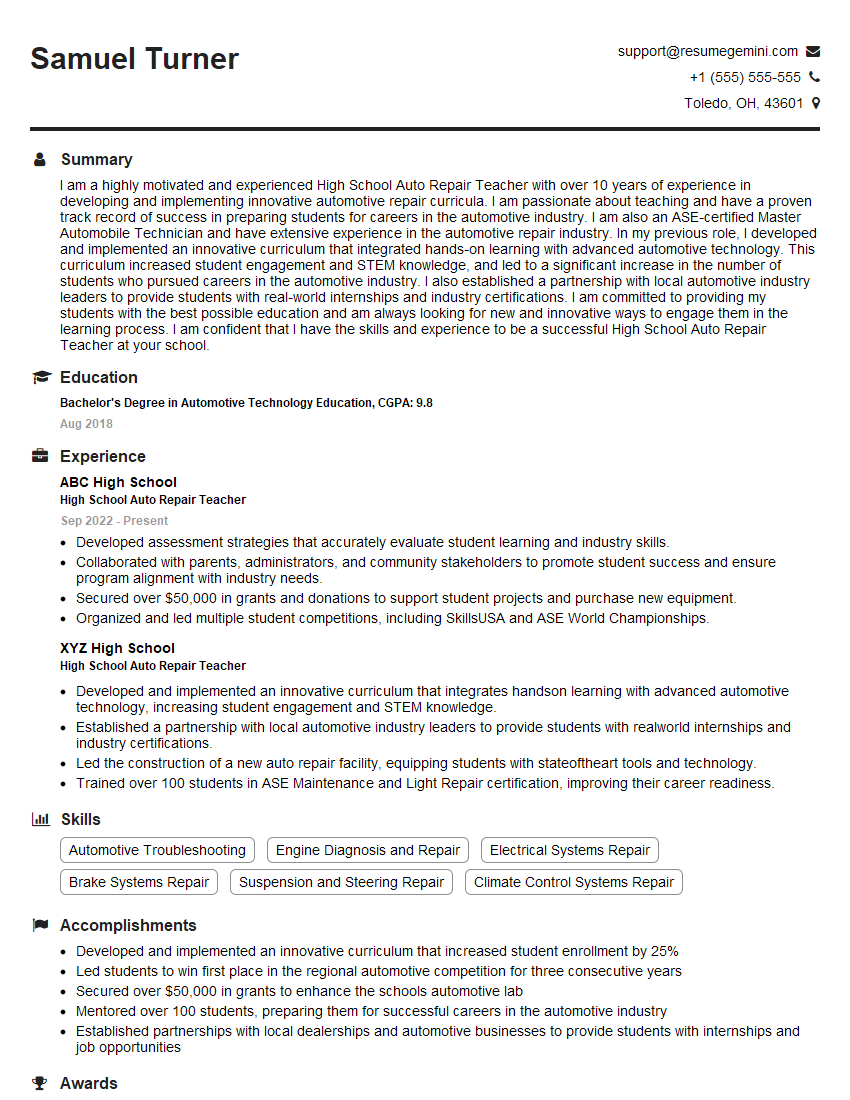
Are you gearing up for a career shift or aiming to ace your next interview? Look no further! We’ve curated a comprehensive guide to help you crack the interview for the coveted High School Auto Repair Teacher position. From understanding the key responsibilities to mastering the most commonly asked questions, this blog has you covered. So, buckle up and let’s embark on this journey together
Acing the interview is crucial, but landing one requires a compelling resume that gets you noticed. Crafting a professional document that highlights your skills and experience is the first step toward interview success. ResumeGemini can help you build a standout resume that gets you called in for that dream job.






Essential Interview Questions For High School Auto Repair Teacher
1. How would you teach students about the different types of engines and their components?
– Begin by introducing the fundamental concepts of engines, including their purpose and operation.
– Use visual aids such as diagrams and videos to illustrate the various types of engines and their components.
– Provide hands-on experiences through practical exercises, allowing students to explore and identify engine components firsthand.
– Explain the functions and interrelationships of different engine components, emphasizing the importance of understanding their roles.
– Facilitate discussions and encourage students to ask questions and share their understanding.
2. Can you describe your approach to teaching students about electrical systems in automobiles?
Safety First:
- Emphasize the importance of safety precautions and proper handling of electrical components.
Theoretical Foundation:
- Explain the principles of electricity and electrical circuits using real-life examples.
- Introduce electrical components such as batteries, starters, and alternators, and their functions.
Hands-On Training:
- Provide practical exercises where students can diagnose and repair electrical faults using multimeters and other tools.
- Incorporate troubleshooting scenarios to develop students’ problem-solving abilities.
Project-Based Learning:
- Assign projects involving electrical system design or troubleshooting to reinforce concepts and foster creativity.
3. How do you assess student progress and track their understanding of automotive repair concepts?
– Utilize a variety of assessment methods to cater to different learning styles.
– Implement written tests and quizzes to evaluate students’ theoretical knowledge.
– Conduct practical assessments through hands-on projects and assignments, allowing students to demonstrate their technical skills.
– Use formative assessments such as observations and discussions to provide ongoing feedback and identify areas for improvement.
– Encourage self-reflection and peer review to promote student engagement and ownership of their learning.
4. What techniques do you employ to engage students and make the learning process interactive?
– Incorporate hands-on activities, simulations, and real-world scenarios to bring concepts to life.
– Use interactive demonstrations to illustrate principles and techniques.
– Facilitate group discussions and problem-solving exercises to encourage collaboration and critical thinking.
– Utilize online resources such as videos, simulations, and virtual reality to enhance engagement and provide diverse learning experiences.
– Encourage students to participate in clubs or competitions related to automotive repair to further explore their interests.
5. How do you stay up-to-date with the latest advancements and technological trends in the automotive industry?
– Regularly attend industry conferences, workshops, and training sessions to acquire knowledge about new technologies.
– Collaborate with industry professionals and experts to gain insights into current practices and developments.
– Read trade publications, research papers, and technical articles to stay abreast of advancements.
– Engage in online forums and communities to connect with other professionals and share knowledge.
– Seek opportunities for professional development by pursuing certifications or specialized courses related to emerging automotive technologies.
6. Can you describe your plans for integrating safety practices and procedures into your teaching?
– Establish clear safety rules and expectations for the classroom and workshop.
– Conduct regular safety briefings and training sessions to ensure students understand proper handling of tools and equipment.
– Incorporate safety exercises and drills into lessons to reinforce safe practices.
– Provide personal protective equipment to students and ensure its proper use.
– Regularly inspect the work area and equipment to identify potential hazards and take corrective actions.
7. How would you foster a positive and inclusive learning environment for students from diverse backgrounds and learning styles?
– Create a welcoming and respectful classroom culture where students feel valued and supported.
– Utilize differentiated instruction to cater to individual learning needs and strengths.
– Incorporate culturally relevant examples and materials to make concepts relatable.
– Establish clear expectations and provide constructive feedback to all students.
– Encourage collaboration and peer support to foster a sense of community.
8. What strategies do you use to differentiate instruction and support students with diverse learning needs?
– Implement tiered lessons with varying levels of complexity and support.
– Provide individualized instruction and support based on student assessments.
– Utilize multi-sensory activities to cater to different learning styles.
– Offer alternative learning formats, such as hands-on projects or videos.
– Encourage collaboration and peer tutoring to foster a supportive environment.
9. How do you incorporate industry-recognized certifications into your curriculum?
– Identify industry-recognized certifications relevant to the course content.
– Integrate certification preparation materials into the curriculum.
– Offer opportunities for students to practice and prepare for certification exams.
– Partner with industry professionals to provide guest lectures and certification workshops.
– Track student progress and provide guidance towards certification goals.
10. Can you describe your approach to teaching students about alternative fuel vehicles and their technologies?
– Introduce the principles of alternative fuel vehicles and their environmental benefits.
– Discuss different types of alternative fuels, such as electric, hybrid, and hydrogen.
– Explain the components and operation of alternative fuel vehicle systems.
– Provide hands-on experiences with alternative fuel vehicles, including troubleshooting and repair.
– Collaborate with industry professionals to bring real-world perspectives and insights.
Interviewers often ask about specific skills and experiences. With ResumeGemini‘s customizable templates, you can tailor your resume to showcase the skills most relevant to the position, making a powerful first impression. Also check out Resume Template specially tailored for High School Auto Repair Teacher.
Career Expert Tips:
- Ace those interviews! Prepare effectively by reviewing the Top 50 Most Common Interview Questions on ResumeGemini.
- Navigate your job search with confidence! Explore a wide range of Career Tips on ResumeGemini. Learn about common challenges and recommendations to overcome them.
- Craft the perfect resume! Master the Art of Resume Writing with ResumeGemini’s guide. Showcase your unique qualifications and achievements effectively.
- Great Savings With New Year Deals and Discounts! In 2025, boost your job search and build your dream resume with ResumeGemini’s ATS optimized templates.
Researching the company and tailoring your answers is essential. Once you have a clear understanding of the High School Auto Repair Teacher‘s requirements, you can use ResumeGemini to adjust your resume to perfectly match the job description.
Key Job Responsibilities
A High School Auto Repair Teacher is responsible for instructing and assessing students in the fundamentals of automotive repair and maintenance. They must have a strong understanding of automotive systems and be able to effectively communicate technical concepts to students. Key job responsibilities include:
1. Instructional Delivery
Develop and deliver lesson plans that align with curriculum standards.
- Incorporate hands-on activities and demonstrations to enhance student understanding.
- Utilize a variety of teaching methods to cater to diverse learning styles.
- Evaluate student progress through assessments, quizzes, and projects.
- Provide individualized support and guidance to students as needed.
2. Classroom Management
Establish and maintain a safe and positive learning environment.
- Enforce classroom rules and procedures.
- Promote student engagement and participation.
- Manage student behavior and address any disciplinary issues.
- Collaborate with administrators and parents to address student concerns.
- Maintain an organized and well-maintained classroom.
3. Automotive Repair and Maintenance
Demonstrate proper techniques for automotive repair and maintenance.
- Diagnose and troubleshoot automotive problems.
- Perform repairs and maintenance on various automotive systems.
- Ensure that all repairs meet industry standards.
- Maintain and update knowledge of automotive technologies and trends.
- Stay abreast of industry best practices and advancements.
4. Student Assessment and Evaluation
Assess student learning and provide feedback.
- Develop and administer assessments to evaluate student knowledge and skills.
- Provide students with timely and constructive feedback on their performance.
- Track student progress and identify areas for improvement.
- Collaborate with parents and administrators to discuss student progress.
- Maintain accurate and up-to-date student records.
Interview Tips
Preparing for the interview is crucial to increase your chances of success. Here are some interview preparation tips to consider:
1. Research the School and Position
Familiarize yourself with the school’s mission, curriculum, and extracurricular activities.
- Research the specific automotive program and its objectives.
- Learn about the school’s demographics, student body, and community involvement.
2. Practice Your Responses
Prepare answers to common interview questions, such as:
- “Tell me about your teaching philosophy and how it aligns with our school’s goals.”
- “Describe your experience in automotive repair and maintenance.”
- “How do you motivate and engage students in the learning process?”
3. Highlight Your Skills and Experience
Emphasize your skills and experience that are relevant to the job, such as:
- Your ability to teach complex technical concepts in a clear and engaging manner.
- Your experience in developing and implementing lesson plans.
- Your expertise in automotive repair and maintenance techniques.
4. Be Enthusiastic and Professional
Convey your passion for teaching and automotive repair.
- Be confident and articulate in your responses.
- Dress professionally and arrive on time for your interview.
Next Step:
Now that you’re armed with interview-winning answers and a deeper understanding of the High School Auto Repair Teacher role, it’s time to take action! Does your resume accurately reflect your skills and experience for this position? If not, head over to ResumeGemini. Here, you’ll find all the tools and tips to craft a resume that gets noticed. Don’t let a weak resume hold you back from landing your dream job. Polish your resume, hit the “Build Your Resume” button, and watch your career take off! Remember, preparation is key, and ResumeGemini is your partner in interview success.