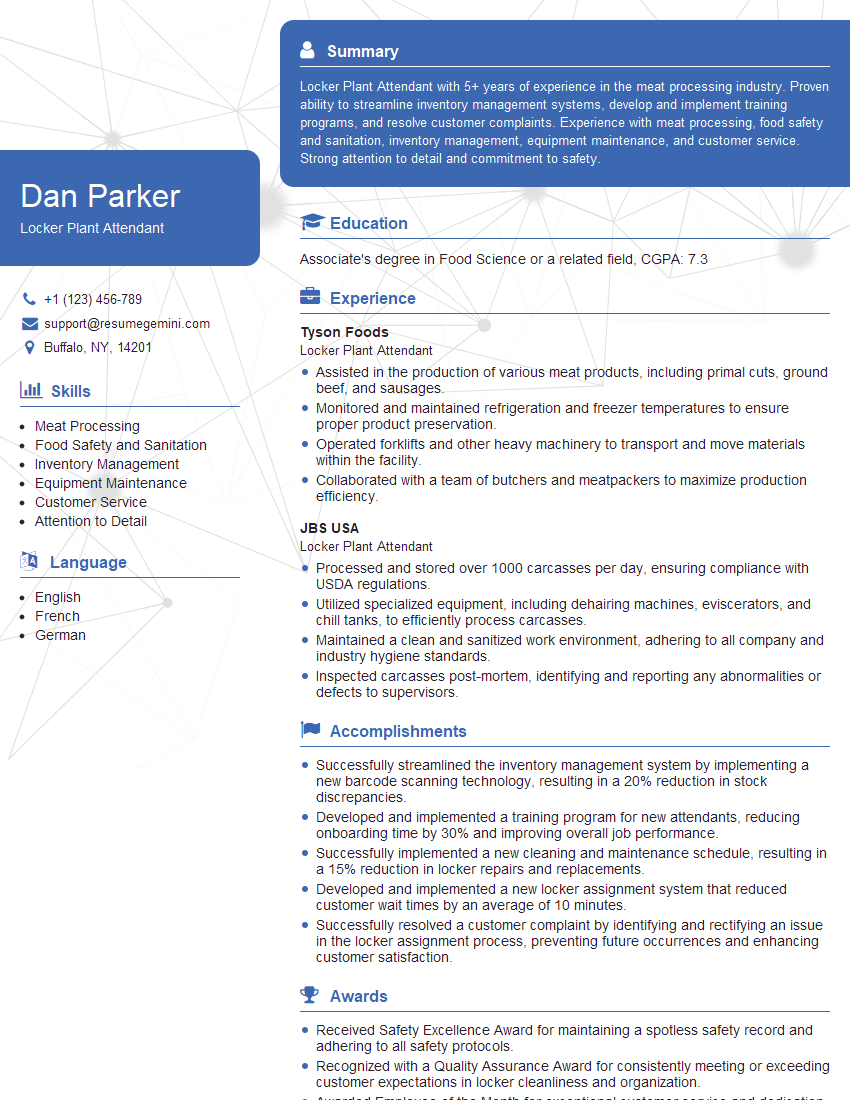
Are you gearing up for an interview for a Locker Plant Attendant position? Whether you’re a seasoned professional or just stepping into the role, understanding what’s expected can make all the difference. In this blog, we dive deep into the essential interview questions for Locker Plant Attendant and break down the key responsibilities of the role. By exploring these insights, you’ll gain a clearer picture of what employers are looking for and how you can stand out. Read on to equip yourself with the knowledge and confidence needed to ace your next interview and land your dream job!
Acing the interview is crucial, but landing one requires a compelling resume that gets you noticed. Crafting a professional document that highlights your skills and experience is the first step toward interview success. ResumeGemini can help you build a standout resume that gets you called in for that dream job.






Essential Interview Questions For Locker Plant Attendant
1. What is the purpose of a meat inspection stamp?
The meat inspection stamp is a government seal that indicates that the meat has been inspected and passed for human consumption. It is required by law to be placed on all meat products that are sold in the United States.
2. What are the different types of meat inspection stamps?
There are two types of meat inspection stamps: the USDA stamp and the state stamp. The USDA stamp indicates that the meat has been inspected by the United States Department of Agriculture (USDA) and has met all of the USDA’s food safety standards.
- The state stamp indicates that the meat has been inspected by a state government agency and has met all of the state’s food safety standards. Both the USDA stamp and the state stamp are valid for use in the United States.
3. What are the steps involved in slaughtering an animal?
The steps involved in slaughtering an animal vary depending on the type of animal and the method of slaughter. However, the general steps are as follows:
- Stunning: The animal is stunned with a captive bolt or a gunshot to render it unconscious.
- Exsanguination: The animal’s throat is cut and the blood is drained out.
- Dressing: The animal’s hide, organs, and other non-edible parts are removed.
- Inspection: The carcass is inspected by a government inspector to ensure that it is fit for human consumption.
- Chilling: The carcass is chilled to prevent spoilage.
4. What are the different types of meat cuts?
There are many different types of meat cuts, each with its own unique flavor and texture. Some of the most popular meat cuts include:
- Steak: A steak is a thick cut of meat that is grilled, roasted, or pan-fried.
- Roast: A roast is a large cut of meat that is roasted in an oven.
- Chop: A chop is a thin cut of meat that is grilled, roasted, or pan-fried.
- Ground meat: Ground meat is meat that has been ground into a fine paste. It can be used to make burgers, meatballs, and other dishes.
5. What are the different methods of cooking meat?
There are many different methods of cooking meat, each with its own unique advantages and disadvantages. Some of the most popular methods of cooking meat include:
- Grilling: Grilling is a method of cooking meat over an open flame or hot coals.
- Roasting: Roasting is a method of cooking meat in an oven at a high temperature.
- Pan-frying: Pan-frying is a method of cooking meat in a pan over medium heat.
- Braising: Braising is a method of cooking meat in a covered pot with a small amount of liquid.
6. What are the different types of meat spoilage?
There are three main types of meat spoilage: bacterial spoilage, chemical spoilage, and enzymatic spoilage.
- Bacterial spoilage is caused by the growth of bacteria on the meat. This type of spoilage can cause the meat to become slimy, discolored, and to develop an off odor.
- Chemical spoilage is caused by the chemical breakdown of the meat. This type of spoilage can cause the meat to become tough, dry, and to develop an off flavor.
- Enzymatic spoilage is caused by the action of enzymes on the meat. This type of spoilage can cause the meat to become tender, juicy, and to develop a more pronounced flavor.
7. What are the different methods of preventing meat spoilage?
There are several different methods of preventing meat spoilage, including:
- Refrigeration: Refrigeration is the most effective way to prevent meat spoilage. Meat should be refrigerated at a temperature of 40°F (4°C) or below.
- Freezing: Freezing is another effective way to prevent meat spoilage. Meat can be frozen for up to 6 months.
- Curing: Curing is a process of preserving meat by adding salt, sugar, or other curing agents. Curing helps to prevent the growth of bacteria and can extend the shelf life of meat.
- Canning: Canning is a process of preserving meat by sealing it in airtight containers and then heating it to a high temperature. Canning can extend the shelf life of meat for up to 5 years.
8. What are the different types of meat preservation?
There are several different types of meat preservation, including:
- Refrigeration: Refrigeration is the most common method of meat preservation. Meat is refrigerated at a temperature of 40°F (4°C) or below to slow the growth of bacteria.
- Freezing: Freezing is another common method of meat preservation. Meat is frozen at a temperature of 0°F (-18°C) or below to stop the growth of bacteria.
- Curing: Curing is a process of preserving meat by adding salt, sugar, or other curing agents. Curing helps to prevent the growth of bacteria and can extend the shelf life of meat.
- Canning: Canning is a process of preserving meat by sealing it in airtight containers and then heating it to a high temperature. Canning can extend the shelf life of meat for up to 5 years.
- Smoking: Smoking is a process of preserving meat by exposing it to smoke. Smoke helps to kill bacteria and can extend the shelf life of meat.
9. What are the different types of meat packaging?
There are several different types of meat packaging, including:
- Vacuum packaging: Vacuum packaging is a process of packaging meat in airtight containers and then removing the air. Vacuum packaging helps to prevent the growth of bacteria and can extend the shelf life of meat.
- Modified atmosphere packaging: Modified atmosphere packaging is a process of packaging meat in airtight containers and then replacing the air with a mixture of gases. Modified atmosphere packaging helps to prevent the growth of bacteria and can extend the shelf life of meat.
- Cryovac packaging: Cryovac packaging is a process of packaging meat in airtight plastic bags. Cryovac packaging helps to prevent the growth of bacteria and can extend the shelf life of meat.
- Skin packaging: Skin packaging is a process of packaging meat in airtight plastic film. Skin packaging helps to prevent the growth of bacteria and can extend the shelf life of meat.
10. What are the different types of meat equipment?
There are several different types of meat equipment, including:
- Meat grinders: Meat grinders are used to grind meat into a fine paste. Meat grinders are available in a variety of sizes and can be used to grind a variety of different types of meat.
- Meat slicers: Meat slicers are used to slice meat into thin slices. Meat slicers are available in a variety of sizes and can be used to slice a variety of different types of meat.
- Meat saws: Meat saws are used to cut meat into large pieces. Meat saws are available in a variety of sizes and can be used to cut a variety of different types of meat.
- Meat tenderizers: Meat tenderizers are used to tenderize meat. Meat tenderizers are available in a variety of forms, including mechanical tenderizers, chemical tenderizers, and enzymatic tenderizers.
- Meat mixers: Meat mixers are used to mix meat with other ingredients. Meat mixers are available in a variety of sizes and can be used to mix a variety of different types of ingredients.
Interviewers often ask about specific skills and experiences. With ResumeGemini‘s customizable templates, you can tailor your resume to showcase the skills most relevant to the position, making a powerful first impression. Also check out Resume Template specially tailored for Locker Plant Attendant.
Career Expert Tips:
- Ace those interviews! Prepare effectively by reviewing the Top 50 Most Common Interview Questions on ResumeGemini.
- Navigate your job search with confidence! Explore a wide range of Career Tips on ResumeGemini. Learn about common challenges and recommendations to overcome them.
- Craft the perfect resume! Master the Art of Resume Writing with ResumeGemini’s guide. Showcase your unique qualifications and achievements effectively.
- Great Savings With New Year Deals and Discounts! In 2025, boost your job search and build your dream resume with ResumeGemini’s ATS optimized templates.
Researching the company and tailoring your answers is essential. Once you have a clear understanding of the Locker Plant Attendant‘s requirements, you can use ResumeGemini to adjust your resume to perfectly match the job description.
Key Job Responsibilities
A Locker Plant Attendant plays a crucial role in maintaining the day-to-day operations of a locker plant. Their primary areas of responsibility include:
1. Locker Maintenance and Management
The attendant is entrusted with ensuring the smooth functioning and upkeep of the lockers. This involves:
- Monitoring lockers for any damages or malfunctions.
- Performing regular inspections, cleaning, and maintenance tasks.
- Identifying and resolving any issues with lockers promptly.
2. Customer Service and Support
The attendant serves as the primary point of contact for customers using the lockers. They are responsible for:
- Providing assistance with locker rentals and usage.
- Handling customer inquiries and resolving any issues or concerns.
- Ensuring customer satisfaction by maintaining a courteous and helpful demeanor.
3. Security and Surveillance
To ensure the safety and security of the locker plant and its users, the attendant is responsible for:
- Monitoring the locker plant area for any suspicious activities or security breaches.
- Reporting any incidents or suspicious behavior to the appropriate authorities.
- Adhering to established security protocols and procedures.
4. Administrative and Compliance
The attendant handles various administrative tasks and ensures compliance with regulations, such as:
- Maintaining records of locker rentals and transactions.
- Collecting payments for locker rentals and handling refunds or exchanges.
- Complying with safety and health regulations related to the locker plant.
Interview Tips
To enhance your chances of success in an interview for a Locker Plant Attendant position, consider these preparation tips:
1. Research and Knowledge
Prior to the interview, thoroughly research the company and the locker plant industry to demonstrate your interest and understanding.
- Learn about the company’s history, values, and operations.
- Familiarize yourself with industry best practices and any specific regulations applicable to locker plants.
2. Skills and Experience
Highlight your relevant skills and experience that align with the job responsibilities. Emphasize:
- Previous experience in customer service and support roles.
- Strong attention to detail and problem-solving abilities.
- Understanding of security and surveillance practices.
3. Behavioral Examples
When answering interview questions, use specific examples to demonstrate your skills and abilities. For example:
- Describe a situation where you effectively resolved a customer complaint.
- Provide an example of a time when you identified and addressed a security concern.
- Explain how you ensure accuracy and attention to detail in your work.
4. En enthusiasm and Commitment
Throughout the interview, convey your enthusiasm for the role and your commitment to providing excellent service to customers.
- Explain your interest in the locker plant industry and why you are motivated to work in this field.
- Express your commitment to providing a safe and secure environment for customers.
Next Step:
Armed with this knowledge, you’re now well-equipped to tackle the Locker Plant Attendant interview with confidence. Remember, preparation is key. So, start crafting your resume, highlighting your relevant skills and experiences. Don’t be afraid to tailor your application to each specific job posting. With the right approach and a bit of practice, you’ll be well on your way to landing your dream job. Build your resume now from scratch or optimize your existing resume with ResumeGemini. Wish you luck in your career journey!