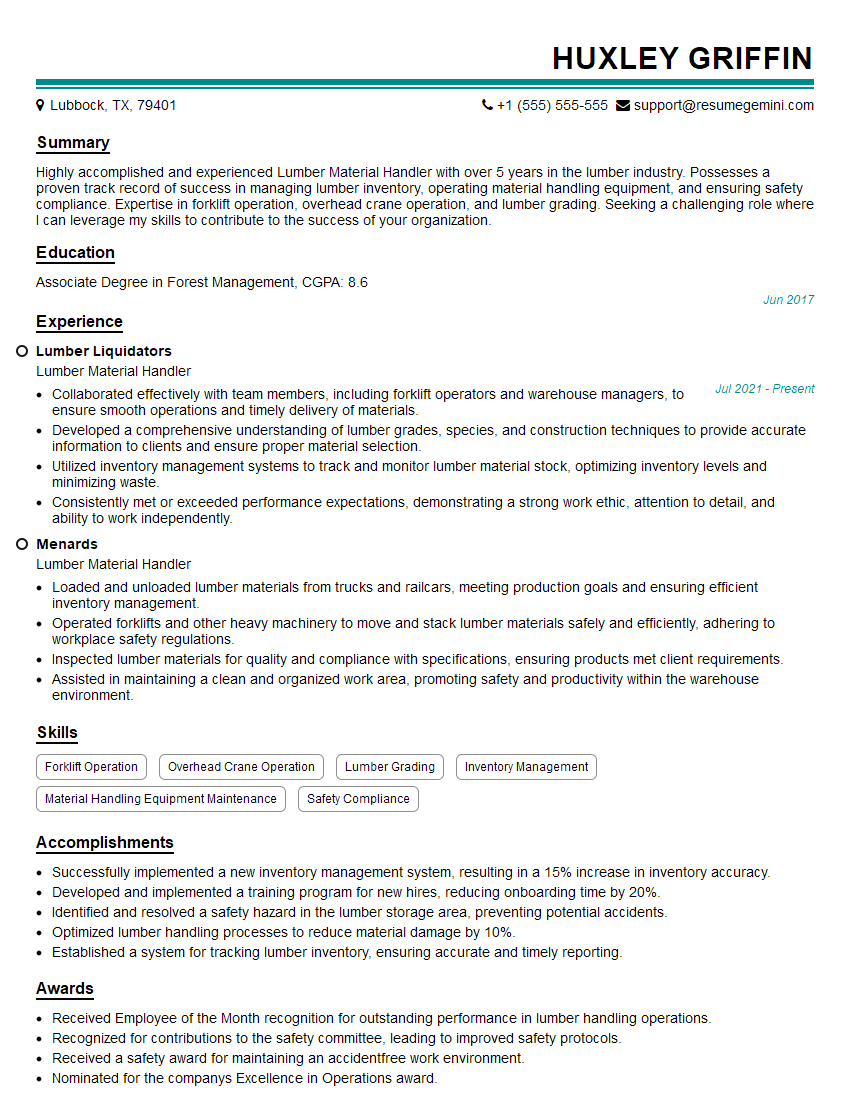
Are you gearing up for a career in Lumber Material Handler? Feeling nervous about the interview questions that might come your way? Don’t worry, you’re in the right place. In this blog post, we’ll dive deep into the most common interview questions for Lumber Material Handler and provide you with expert-backed answers. We’ll also explore the key responsibilities of this role so you can tailor your responses to showcase your perfect fit.
Acing the interview is crucial, but landing one requires a compelling resume that gets you noticed. Crafting a professional document that highlights your skills and experience is the first step toward interview success. ResumeGemini can help you build a standout resume that gets you called in for that dream job.






Essential Interview Questions For Lumber Material Handler
1. How would you ensure the lumber is properly graded and meet customer specifications?
I would begin by visually inspecting the lumber for any noticeable defects or imperfections. I would also use a moisture meter to ensure that the lumber meets the required moisture content. Additionally, I would use a grading machine to determine the grade of the lumber and ensure that it meets customer specifications.
2. What are the potential hazards associated with handling lumber and how would you minimize the risks?
Personal Protective Equipment
- Wear appropriate personal protective equipment (PPE), such as safety glasses, gloves, and a hard hat, to protect myself from flying debris, splinters, and falling objects.
Proper Lifting Techniques
- Use proper lifting techniques to avoid strains and injuries.
- Bend at the knees and lift with my legs, not my back.
- Keep the load close to my body.
- Get help from a coworker if the load is too heavy.
Safe Work Environment
- Keep the work area clean and free of tripping hazards.
- Use caution when working near machinery.
- Be aware of my surroundings and other workers.
3. How would you organize and maintain the lumber storage area to ensure efficient retrieval?
I would organize the lumber storage area by type, size, and grade. I would also ensure that the lumber is stacked neatly and securely to prevent it from falling or becoming damaged. Additionally, I would keep a record of the inventory and track the movement of lumber to ensure that it is used efficiently.
4. What are the different types of lumber you have handled and what are their properties?
I have handled a variety of lumber types, including:
- Softwoods: Pine, fir, spruce, and cedar are commonly used for framing, sheathing, and siding due to their strength and durability.
- Hardwoods: Oak, maple, cherry, and walnut are known for their hardness and durability, and are often used for flooring, furniture, and cabinetry.
- Engineered lumber: Plywood, oriented strand board (OSB), and laminated veneer lumber (LVL) are manufactured wood products that offer strength and stability, and are often used in structural applications.
5. How would you prioritize multiple tasks and manage your time effectively to meet deadlines?
I would begin by creating a to-do list and prioritizing the tasks based on their importance and urgency. I would then allocate my time accordingly and focus on completing the most important tasks first. I would also use a calendar or planner to keep track of deadlines and schedule my time effectively.
6. What types of equipment have you used in the past and how comfortable are you operating heavy machinery?
I have experience operating a variety of equipment, including forklifts, cranes, and conveyors. I am comfortable operating heavy machinery and have received training on safety procedures and proper operation. I am also familiar with the maintenance and repair of heavy machinery.
7. How do you handle working in a fast-paced and physically demanding environment?
I am used to working in a fast-paced and physically demanding environment. I am able to work independently and as part of a team to meet deadlines. I am also able to lift heavy objects and work in a variety of weather conditions.
8. How would you ensure the proper loading and unloading of lumber to minimize damage and maintain safety?
- Inspect the lumber for any damage before loading or unloading.
- Use proper lifting techniques to avoid strains and injuries.
- Secure the lumber properly to prevent it from shifting or falling.
- Use caution when working near machinery and other vehicles.
9. What techniques do you use to ensure accuracy when measuring and cutting lumber?
- Use a measuring tape or ruler to ensure accurate measurements.
- Use a saw guide or jig to ensure straight cuts.
- Double-check measurements and cuts before proceeding.
10. Describe a situation where you had to solve a problem or overcome a challenge while working as a Lumber Material Handler.
I once had to find a way to move a large quantity of lumber from one location to another in a short amount of time. I used a forklift to move the lumber, but the forklift was not able to reach the desired location. I ended up using a combination of a forklift and a manual pallet jack to move the lumber safely and efficiently.
Interviewers often ask about specific skills and experiences. With ResumeGemini‘s customizable templates, you can tailor your resume to showcase the skills most relevant to the position, making a powerful first impression. Also check out Resume Template specially tailored for Lumber Material Handler.
Career Expert Tips:
- Ace those interviews! Prepare effectively by reviewing the Top 50 Most Common Interview Questions on ResumeGemini.
- Navigate your job search with confidence! Explore a wide range of Career Tips on ResumeGemini. Learn about common challenges and recommendations to overcome them.
- Craft the perfect resume! Master the Art of Resume Writing with ResumeGemini’s guide. Showcase your unique qualifications and achievements effectively.
- Great Savings With New Year Deals and Discounts! In 2025, boost your job search and build your dream resume with ResumeGemini’s ATS optimized templates.
Researching the company and tailoring your answers is essential. Once you have a clear understanding of the Lumber Material Handler‘s requirements, you can use ResumeGemini to adjust your resume to perfectly match the job description.
Key Job Responsibilities
The Lumber Material Handler is accountable for receiving, inspecting, and handling lumber and building materials in a safe and efficient manner. This role requires a strong physical presence and ability to operate machinery and equipment in a warehouse setting.
1. Inspecting and Receiving
The job holder inspects lumber and building materials for quality and quantity, ensuring they meet the specifications of the order.
- Identifying and verifying lumber species and grades
- Inspecting materials for damages, defects, and shortages
2. Loading and Unloading
The job holder operates forklifts and other equipment to load and unload lumber and building materials, ensuring safe and efficient movement of materials.
- Using forklifts to load and unload heavy materials
- Operating cranes or other equipment to move large or bulky items
3. Storage and Inventory Management
The job holder is responsible for storing and managing inventory, ensuring materials are properly organized and accounted for.
- Maintaining proper storage conditions (e.g., elevation, ventilation, protection from elements)
- Using inventory management systems to track incoming and outgoing materials
4. Other Duties
The job holder may also perform additional duties, such as maintaining equipment and performing minor repairs.
- Cleaning and maintaining work areas
- Assisting with other tasks as assigned by supervisor
Interview Tips
Preparing for an interview is crucial, as it shows the interviewer you are interested in the position and have taken the time to learn about the company and the role.
1. Research the Company and the Role
Visit the company website and social media pages to gain insights into their culture, values, and industry standing. This demonstrates your enthusiasm for the position and the company itself.
- Researching similar roles in the industry to understand the expected responsibilities and qualifications.
- Reading industry publications or attending webinars to stay up-to-date on trends and best practices in lumber handling.
2. Practice Your Answers
Prepare thoughtful and concise answers to common interview questions, such as “Tell me about yourself” and “Why are you interested in this role?”
- Rehearsing your answers aloud to ensure your delivery is clear and confident.
- Seeking feedback from a friend or family member to improve your presentation.
3. Highlight Your Skills and Experience
Carefully review the job description to identify the key skills and experience required for the role. Emphasize how your qualifications align with the needs of the company.
- Quantifying your accomplishments by using specific metrics or examples.
- Preparing examples of how you have successfully handled similar responsibilities in previous roles.
4. Prepare Questions to Ask
Asking thoughtful questions at the end of the interview demonstrates your engagement and interest in the position. Prepare questions that relate to the role, the company, or the industry.
- Inquiring about the company’s growth plans or industry outlook.
- Asking about opportunities for professional development or advancement within the organization.
Next Step:
Now that you’re armed with interview-winning answers and a deeper understanding of the Lumber Material Handler role, it’s time to take action! Does your resume accurately reflect your skills and experience for this position? If not, head over to ResumeGemini. Here, you’ll find all the tools and tips to craft a resume that gets noticed. Don’t let a weak resume hold you back from landing your dream job. Polish your resume, hit the “Build Your Resume” button, and watch your career take off! Remember, preparation is key, and ResumeGemini is your partner in interview success.