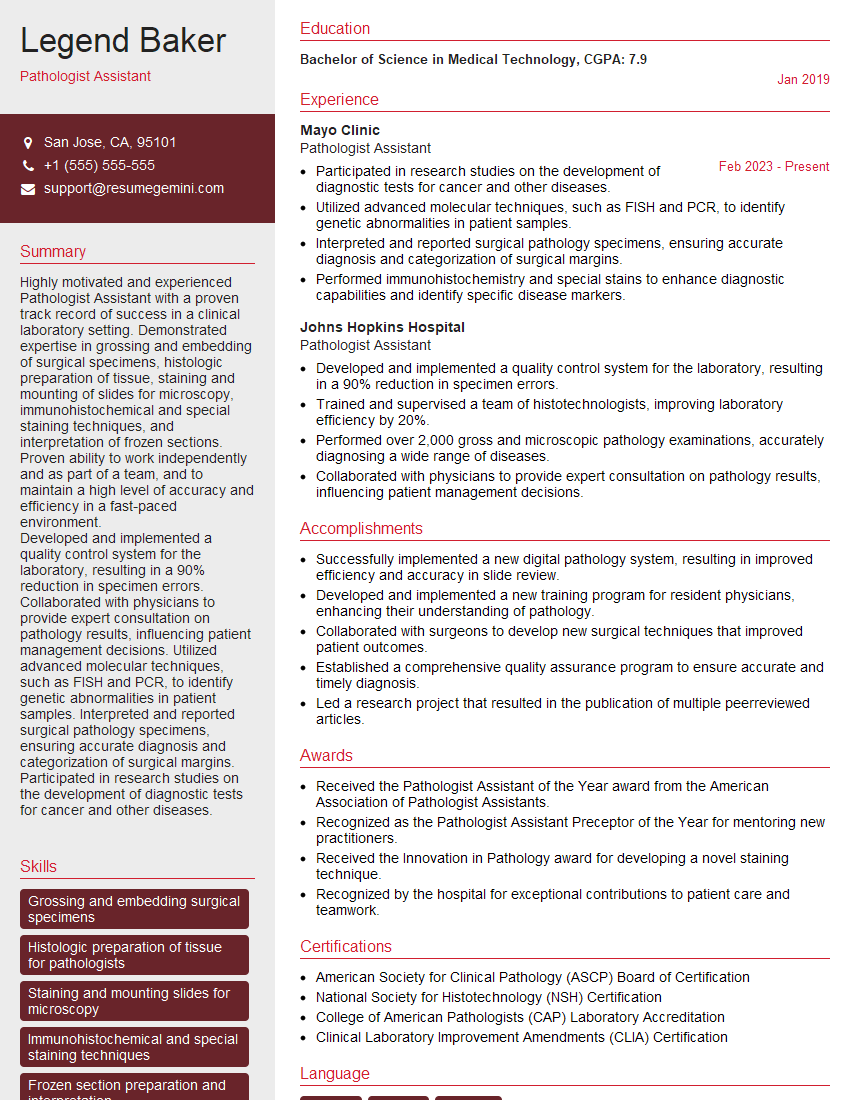
Are you gearing up for a career in Pathologist Assistant? Feeling nervous about the interview questions that might come your way? Don’t worry, you’re in the right place. In this blog post, we’ll dive deep into the most common interview questions for Pathologist Assistant and provide you with expert-backed answers. We’ll also explore the key responsibilities of this role so you can tailor your responses to showcase your perfect fit.
Acing the interview is crucial, but landing one requires a compelling resume that gets you noticed. Crafting a professional document that highlights your skills and experience is the first step toward interview success. ResumeGemini can help you build a standout resume that gets you called in for that dream job.






Essential Interview Questions For Pathologist Assistant
1. What are the key responsibilities of a Pathologist Assistant?
- Prepare tissue samples for examination by pathologists
- Perform laboratory tests and procedures
- Assist in autopsies and other medical procedures
- Maintain accurate records of laboratory findings
- Provide technical support to pathologists and other healthcare professionals
2. Describe the process of preparing a tissue sample for examination by a pathologist.
Gross Examination
- Examine the specimen macroscopically
- Document size, shape, color, and consistency
- Identify any gross abnormalities
Tissue Processing
- Fix the tissue in a preservative solution
- Embed the tissue in paraffin wax
- Cut thin sections of the tissue
- Mount the sections on glass slides
Staining
- Apply stains to the tissue sections
- Stains highlight specific cellular components
- Allow pathologist to visualize and interpret the tissue
3. What are the different types of laboratory tests and procedures that a Pathologist Assistant may perform?
- Histopathology: Examines tissue samples to diagnose diseases
- Cytology: Examines cells to diagnose diseases
- Immunohistochemistry: Uses antibodies to identify specific proteins in tissue samples
- Molecular diagnostics: Uses molecular techniques to identify genetic mutations and other abnormalities
- Forensic pathology: Examines evidence in criminal cases
4. What is the role of a Pathologist Assistant in an autopsy?
- Assist the pathologist in performing the autopsy
- Prepare the body for examination
- Collect and preserve tissue samples
- Document the findings of the autopsy
- Discuss the findings with the pathologist
5. What are the qualities of a successful Pathologist Assistant?
- Excellent technical skills
- Strong attention to detail
- Ability to work independently and as part of a team
- Excellent communication skills
- Commitment to patient care
6. What are the challenges facing Pathologist Assistants in today’s healthcare environment?
- Increasing demand for pathology services
- Shortage of qualified Pathologist Assistants
- Advances in technology that are changing the field of pathology
- Need to maintain proficiency in a rapidly evolving field
7. What are your career goals as a Pathologist Assistant?
I am passionate about the field of pathology and I am committed to providing high-quality patient care. My career goal is to become a highly skilled and experienced Pathologist Assistant and to make a significant contribution to the field.
8. Why are you interested in working at our institution?
I am very interested in working at your institution because of its reputation for excellence in pathology. I am particularly impressed with your institution’s commitment to providing high-quality patient care and your investment in cutting-edge technology.
9. What are your strengths and weaknesses as a Pathologist Assistant?
Strengths
- Excellent technical skills
- Strong attention to detail
- Ability to work independently and as part of a team
- Excellent communication skills
- Commitment to patient care
Weaknesses
- Limited experience with some of the newer technologies used in pathology
- Need to improve my time management skills
10. Do you have any questions for me?
I am very interested in the position of Pathologist Assistant at your institution. I have a few questions that I would like to ask you.
- What is the typical workload for a Pathologist Assistant at your institution?
- What are the opportunities for professional development?
- What is the culture of the pathology department like?
Interviewers often ask about specific skills and experiences. With ResumeGemini‘s customizable templates, you can tailor your resume to showcase the skills most relevant to the position, making a powerful first impression. Also check out Resume Template specially tailored for Pathologist Assistant.
Career Expert Tips:
- Ace those interviews! Prepare effectively by reviewing the Top 50 Most Common Interview Questions on ResumeGemini.
- Navigate your job search with confidence! Explore a wide range of Career Tips on ResumeGemini. Learn about common challenges and recommendations to overcome them.
- Craft the perfect resume! Master the Art of Resume Writing with ResumeGemini’s guide. Showcase your unique qualifications and achievements effectively.
- Great Savings With New Year Deals and Discounts! In 2025, boost your job search and build your dream resume with ResumeGemini’s ATS optimized templates.
Researching the company and tailoring your answers is essential. Once you have a clear understanding of the Pathologist Assistant‘s requirements, you can use ResumeGemini to adjust your resume to perfectly match the job description.
Key Job Responsibilities
Pathologist assistants are health care professionals who are responsible for providing support to pathologists in the diagnosis and treatment of disease. They perform a variety of tasks, including:
1. Preparing and examining tissue
Pathologist assistants help to prepare and examine tissue samples. They cut thin sections of tissue, stain them with dyes, and mount them on slides. The slides are then examined under a microscope by a pathologist, who will make a diagnosis based on the appearance of the tissue.
2. Performing laboratory tests
Pathologist assistants also perform laboratory tests. These tests may include blood tests, urine tests, and other tests designed to help diagnose disease. They also operate and maintain laboratory equipment.
3. Assisting in autopsies
Pathologist assistants may also assist in autopsies. Autopsies are performed to determine the cause of death. Pathologist assistants help to prepare the body for autopsy, and they may also collect samples of tissue for examination.
4. Providing technical support
Pathologist assistants also provide technical support to pathologists. This may include helping to develop new tests and procedures, and troubleshooting problems with laboratory equipment.
Interview Tips
1. Research the organization
Before your interview, take some time to research the organization you are applying to. This will help you to understand their mission, values, and culture. You can also learn about their specific needs and challenges. This information will help you to tailor your answers to the interviewer’s questions and to demonstrate how you can contribute to the organization.
2. Practice your answers
Once you have researched the organization, take some time to practice your answers to common interview questions. This will help you to feel more confident and prepared during the interview. You can practice with a friend, family member, or career counselor. This could include questions related to your technical skills and knowledge, your experience with laboratory equipment, and your ability to work independently and as part of a team.
3. Be prepared to talk about your skills and experience
The interviewer will want to know about your skills and experience. Be prepared to talk about your education, training, and work history. You should also be prepared to discuss your strengths and weaknesses. You can highlight your ability to prepare and examine tissue samples, perform laboratory tests, assist in autopsies, and provide technical support.
4. Ask questions
At the end of the interview, be sure to ask the interviewer questions. This shows that you are interested in the position and that you are taking the interview seriously. You can ask about the organization’s culture, the specific responsibilities of the position, and the opportunities for professional development.
5. Follow up
After the interview, be sure to follow up with the interviewer. Thank them for their time and reiterate your interest in the position. You can also provide them with any additional information that you think they may find helpful.
Next Step:
Now that you’re armed with interview-winning answers and a deeper understanding of the Pathologist Assistant role, it’s time to take action! Does your resume accurately reflect your skills and experience for this position? If not, head over to ResumeGemini. Here, you’ll find all the tools and tips to craft a resume that gets noticed. Don’t let a weak resume hold you back from landing your dream job. Polish your resume, hit the “Build Your Resume” button, and watch your career take off! Remember, preparation is key, and ResumeGemini is your partner in interview success.