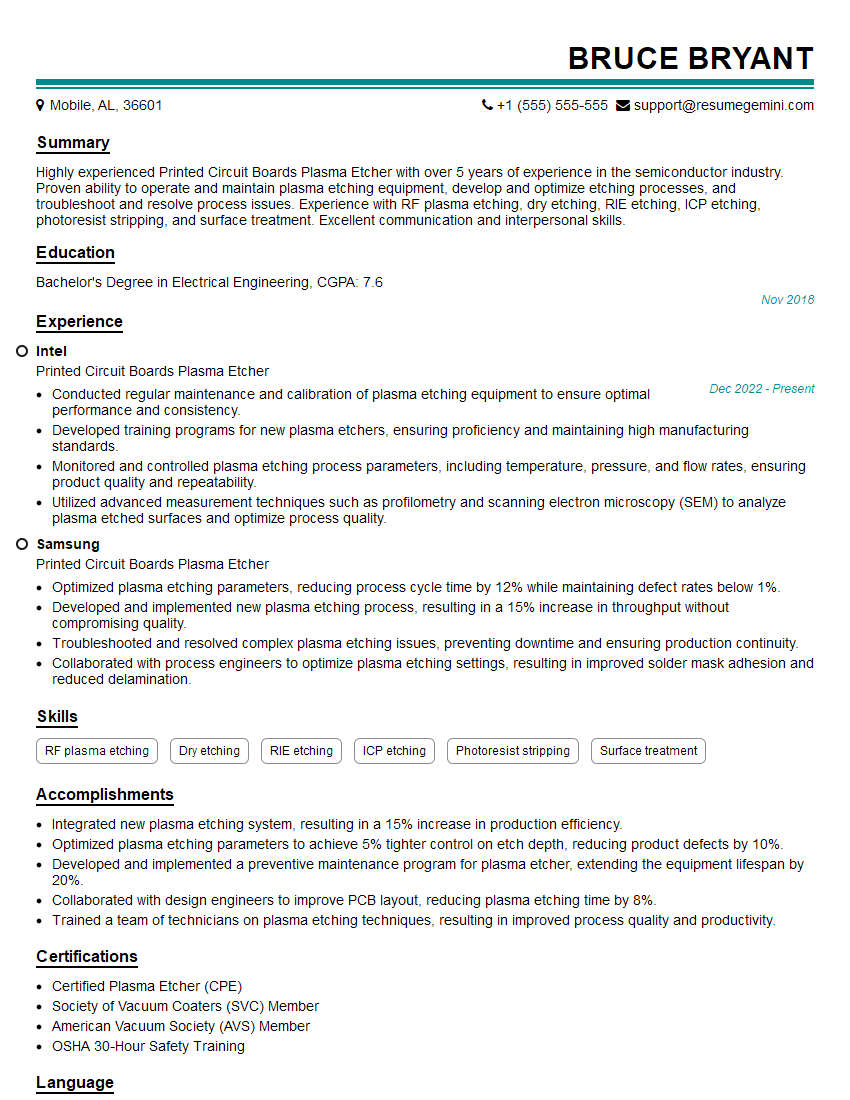
Are you gearing up for a career in Printed Circuit Boards Plasma Etcher? Feeling nervous about the interview questions that might come your way? Don’t worry, you’re in the right place. In this blog post, we’ll dive deep into the most common interview questions for Printed Circuit Boards Plasma Etcher and provide you with expert-backed answers. We’ll also explore the key responsibilities of this role so you can tailor your responses to showcase your perfect fit.
Acing the interview is crucial, but landing one requires a compelling resume that gets you noticed. Crafting a professional document that highlights your skills and experience is the first step toward interview success. ResumeGemini can help you build a standout resume that gets you called in for that dream job.






Essential Interview Questions For Printed Circuit Boards Plasma Etcher
1. What are the different types of plasma etchers used in PCB fabrication, and what are their pros and cons?
There are three major types of plasma etchers used in PCB fabrication:
- Reactive ion etching (RIE)
- Capacitively coupled plasma etching (CCP)
- Inductively coupled plasma etching (ICP)
RIE uses a radio frequency (RF) field to generate a plasma that is used to etch the PCB. CCP uses a DC field to generate a plasma, and ICP uses an RF field to generate a plasma in an inductive coil. Each type of etcher has its own pros and cons.
RIE is the most versatile type of etcher and can be used to etch a wide variety of materials. However, it can be relatively slow and can cause damage to the PCB surface. CCP is faster than RIE and can produce more uniform etch profiles. However, it can be more difficult to control the etch process and can cause more damage to the PCB surface. ICP is the fastest type of etcher and can produce the most uniform etch profiles. However, it can be more expensive than RIE and CCP.
2. What are the key parameters that control the plasma etching process, and how do they affect the etch rate and profile?
The key parameters that control the plasma etching process include:
- Plasma power
- Gas pressure
- Etching time
- Substrate temperature
Plasma power is the most important parameter that controls the etch rate. Higher plasma power results in a higher etch rate. Gas pressure also affects the etch rate, with higher gas pressure resulting in a lower etch rate. Etching time is another important parameter that controls the etch rate. Longer etching times result in a deeper etch. Substrate temperature can also affect the etch rate, with higher substrate temperatures resulting in a higher etch rate.
The etch profile is also affected by the plasma etching process parameters. The etch profile is the shape of the etched surface. A uniform etch profile is desirable, as it indicates that the etch process is well-controlled. Non-uniform etch profiles can be caused by a variety of factors, including variations in the plasma density, gas pressure, and substrate temperature.
3. What are the different types of plasma chemistries used in PCB fabrication, and what are their advantages and disadvantages?
The most common plasma chemistries used in PCB fabrication include:
- Oxygen (O2)
- Chlorine (Cl2)
- Fluorine (F)
- Sulfur hexafluoride (SF6)
- Carbon tetrafluoride (CF4)
Oxygen is used to etch a variety of materials, including copper, aluminum, and silicon. Chlorine is used to etch copper and aluminum. Fluorine is used to etch silicon and silicon dioxide. SF6 is used to etch silicon, silicon dioxide, and aluminum. CF4 is used to etch silicon, silicon dioxide, and copper.
The advantages and disadvantages of each plasma chemistry depend on the material being etched and the desired etch profile.
4. What are the safety precautions that must be taken when operating a plasma etcher?
Plasma etching is a hazardous process that can release harmful chemicals and vapors. The following safety precautions must be taken when operating a plasma etcher:
- Wear proper personal protective equipment (PPE), including gloves, safety glasses, and a lab coat.
- Operate the plasma etcher in a well-ventilated area.
- Never look directly into the plasma.
- Do not touch the plasma chamber or the substrate during etching.
- Handle and dispose of chemicals and waste materials properly.
5. What are the maintenance procedures that must be performed on a plasma etcher to ensure optimal performance?
The following maintenance procedures must be performed on a plasma etcher to ensure optimal performance:
- Clean the plasma chamber regularly.
- Replace the plasma source periodically.
- Calibrate the plasma etcher regularly.
- Inspect the plasma etcher for any damage or wear and tear.
By following these maintenance procedures, you can help ensure that your plasma etcher will operate safely and efficiently for many years to come.
6. What are the troubleshooting tips for common problems that can occur with plasma etchers?
The following are some troubleshooting tips for common problems that can occur with plasma etchers:
- If the plasma etcher is not etching the material properly, check the following:
- The plasma power is set correctly.
- The gas pressure is set correctly.
- The etching time is set correctly.
- The substrate temperature is set correctly.
- The plasma chemistry is correct for the material being etched.
- If the plasma etcher is not producing a uniform etch profile, check the following:
- The plasma density is uniform across the substrate.
- The gas pressure is uniform across the substrate.
- The substrate temperature is uniform across the substrate.
- If the plasma etcher is not operating safely, check the following:
- The plasma etcher is properly grounded.
- The plasma etcher is properly ventilated.
- The plasma etcher is properly shielded.
7. What are the recent advances in plasma etching technology?
The following are some of the recent advances in plasma etching technology:
- The development of new plasma sources, such as high-density plasma sources and inductively coupled plasma sources.
- The development of new plasma chemistries, such as fluorine-based chemistries and sulfur-based chemistries.
- The development of new plasma etching techniques, such as anisotropic etching and isotropic etching.
- The development of new plasma etching equipment, such as fully automated plasma etchers and plasma etchers with in-situ metrology.
8. What are the future trends in plasma etching technology?
The following are some of the future trends in plasma etching technology:
- The development of even more powerful and efficient plasma sources.
- The development of even more selective and uniform plasma chemistries.
- The development of even more advanced plasma etching techniques.
- The development of even more automated and integrated plasma etching equipment.
9. How do you stay up-to-date on the latest advances in plasma etching technology?
I stay up-to-date on the latest advances in plasma etching technology by reading technical journals, attending conferences, and networking with other professionals in the field.
10. What are your career goals?
My career goals are to:
- Become a world-renowned expert in plasma etching technology.
- Develop new plasma etching techniques that will revolutionize the electronics industry.
- Start my own company that will provide plasma etching services to the world’s leading semiconductor manufacturers.
Interviewers often ask about specific skills and experiences. With ResumeGemini‘s customizable templates, you can tailor your resume to showcase the skills most relevant to the position, making a powerful first impression. Also check out Resume Template specially tailored for Printed Circuit Boards Plasma Etcher.
Career Expert Tips:
- Ace those interviews! Prepare effectively by reviewing the Top 50 Most Common Interview Questions on ResumeGemini.
- Navigate your job search with confidence! Explore a wide range of Career Tips on ResumeGemini. Learn about common challenges and recommendations to overcome them.
- Craft the perfect resume! Master the Art of Resume Writing with ResumeGemini’s guide. Showcase your unique qualifications and achievements effectively.
- Great Savings With New Year Deals and Discounts! In 2025, boost your job search and build your dream resume with ResumeGemini’s ATS optimized templates.
Researching the company and tailoring your answers is essential. Once you have a clear understanding of the Printed Circuit Boards Plasma Etcher‘s requirements, you can use ResumeGemini to adjust your resume to perfectly match the job description.
Key Job Responsibilities
The Printed Circuit Boards Plasma Etcher is responsible for handling the operation and maintenance of plasma etching equipment, ensuring the precision and accuracy of the etching process for printed circuit boards (PCBs). Their primary tasks involve setting up, monitoring, and troubleshooting the equipment to achieve optimal performance, resulting in high-quality PCBs for various electronic devices.
1. Equipment Operation
Operate plasma etching equipment efficiently, following established process parameters and safety protocols.
- Configure and adjust equipment settings to meet specific etching requirements.
- Load and unload PCBs into the etching chamber, ensuring proper alignment and handling.
- Monitor the etching process closely, making necessary adjustments to maintain optimal conditions.
2. Quality Control
Inspect and assess the quality of etched PCBs, adhering to stringent quality standards.
- Examine etched PCBs for defects, such as shorts, opens, or contamination.
- Perform electrical tests to verify the conductivity and functionality of the etched circuits.
- Document and report any deviations from quality specifications, initiating corrective actions as needed.
3. Equipment Maintenance
Maintain and troubleshoot plasma etching equipment to ensure smooth operation and prevent downtime.
- Conduct regular inspections, cleaning, and calibration of equipment to maintain optimal performance.
- Diagnose and troubleshoot equipment malfunctions, identifying and resolving issues promptly.
- Collaborate with maintenance technicians to perform major repairs or overhauls.
4. Process Optimization
Analyze and improve plasma etching processes to enhance efficiency and quality.
- Monitor process parameters and identify areas for improvement, such as reducing cycle times or minimizing defects.
- Experiment with different etching chemistries and process conditions to optimize results.
- Implement process improvements and document the changes for future reference.
Interview Tips
To ace the interview for the role of Printed Circuit Boards Plasma Etcher, it’s essential to prepare thoroughly and demonstrate your skills and knowledge. Here are some tips to help you stand out:
1. Research the Company and Role:
Before the interview, take the time to research the company’s background, products, and culture. Familiarize yourself with the specific requirements and responsibilities of the Plasma Etcher role within their organization.
2. Highlight Your Technical Expertise:
Emphasize your technical skills and knowledge in plasma etching processes. Discuss your experience in operating, maintaining, and troubleshooting plasma etching equipment. Provide specific examples of how you have successfully resolved process issues or optimized etching results.
3. Showcase Your Quality Assurance Skills:
Demonstrate your ability to perform meticulous inspections and electrical testing to ensure the quality of etched PCBs. Highlight your adherence to quality standards and your experience in identifying and resolving defects.
4. Emphasize Your Problem-Solving Abilities:
Interviewers will be interested in your ability to diagnose and troubleshoot equipment malfunctions. Describe situations where you have successfully identified and resolved complex issues, ensuring minimal downtime and maintaining production efficiency.
5. Prepare Examples of Process Improvements:
If you have experience in analyzing and improving plasma etching processes, be sure to highlight these accomplishments. Quantify the benefits of your improvements, such as reduced cycle times or increased yield.
6. Be Enthusiastic and Ask Questions:
Show your enthusiasm for the role and the industry. Ask thoughtful questions during the interview to demonstrate your interest and eagerness to learn more. This will leave a positive impression on the interviewers.
7. Practice Your Answers:
To build confidence and deliver polished responses, practice answering common interview questions related to plasma etching, quality control, and problem-solving. Consider using the STAR method (Situation-Task-Action-Result) to structure your answers effectively.
8. Dress Professionally and Arrive on Time:
First impressions matter. Dress professionally and arrive for the interview on time to demonstrate your respect for the interviewer’s time and the position you are applying for.
Next Step:
Armed with this knowledge, you’re now well-equipped to tackle the Printed Circuit Boards Plasma Etcher interview with confidence. Remember, preparation is key. So, start crafting your resume, highlighting your relevant skills and experiences. Don’t be afraid to tailor your application to each specific job posting. With the right approach and a bit of practice, you’ll be well on your way to landing your dream job. Build your resume now from scratch or optimize your existing resume with ResumeGemini. Wish you luck in your career journey!