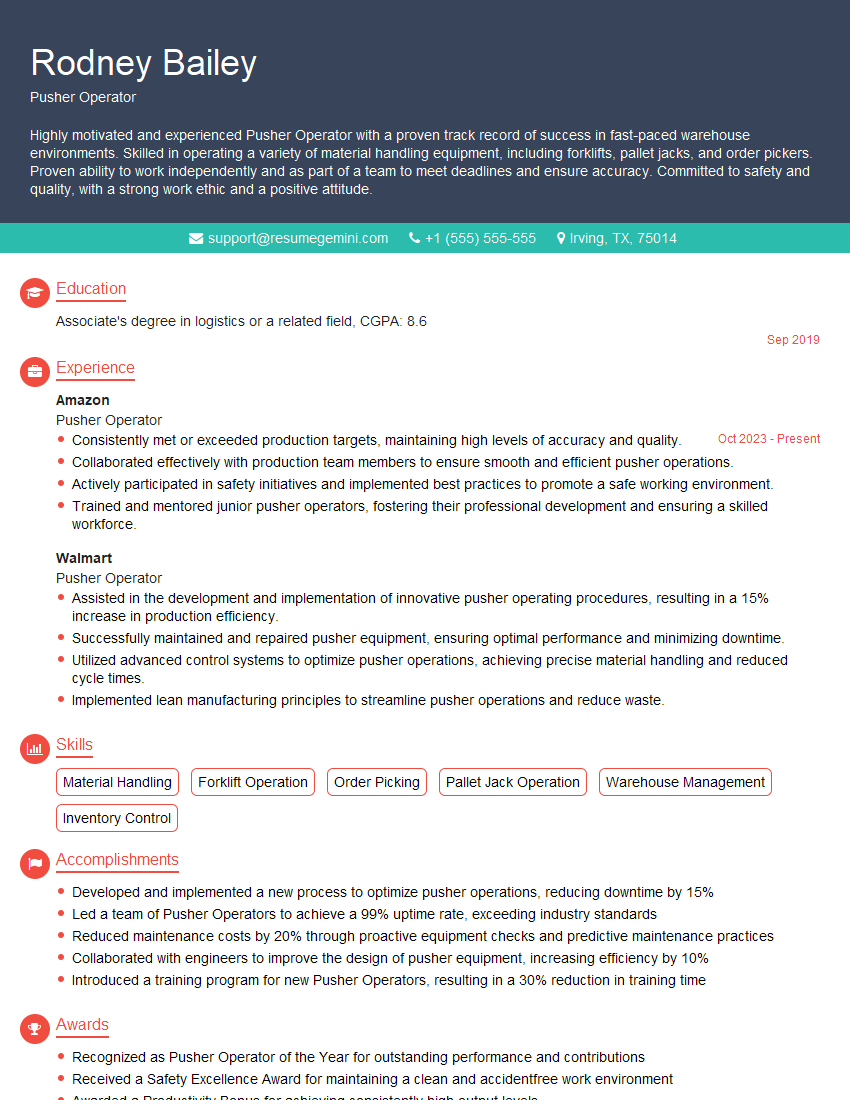
Are you gearing up for a career in Pusher Operator? Feeling nervous about the interview questions that might come your way? Don’t worry, you’re in the right place. In this blog post, we’ll dive deep into the most common interview questions for Pusher Operator and provide you with expert-backed answers. We’ll also explore the key responsibilities of this role so you can tailor your responses to showcase your perfect fit.
Acing the interview is crucial, but landing one requires a compelling resume that gets you noticed. Crafting a professional document that highlights your skills and experience is the first step toward interview success. ResumeGemini can help you build a standout resume that gets you called in for that dream job.






Essential Interview Questions For Pusher Operator
1. Discuss the key responsibilities of a Pusher Operator?
As a Pusher Operator, my key responsibilities include:
- Monitoring and maintaining the Pusher infrastructure to ensure high availability and performance.
- Responding to and resolving any issues or outages that may arise.
- Working closely with the development team to understand their needs and ensure that Pusher meets their requirements.
- Collaborating with other teams within the organization to ensure that Pusher is integrated effectively with other systems.
- Providing support to customers and resolving any issues they may encounter.
2. Explain how you would troubleshoot a performance issue with Pusher?
Steps for troubleshooting performance issue with Pusher
- Gather information about the issue, including the time it occurred, the duration, and any relevant error messages.
- Review the Pusher logs and metrics to identify any unusual activity or patterns.
- Check the status of the Pusher infrastructure and ensure that all components are operational.
- Test the Pusher API using a tool like curl or Postman to reproduce the issue.
- Contact the Pusher support team if the issue cannot be resolved internally.
Possible causes of performance issue with Pusher
- High traffic volume
- Issues with the network or infrastructure
- Misconfiguration of the Pusher application or API
- Bugs or issues in the client-side code
- Third-party integrations or services
3. Describe the best practices for scaling a Pusher application?
- Use a scalable infrastructure that can handle high traffic volumes.
- Monitor the performance of the Pusher application and make adjustments as needed.
- Implement caching and other techniques to reduce the load on the Pusher infrastructure.
- Use a CDN to distribute content to users more efficiently.
- Consider using a managed Pusher service to offload the operational burden of managing the infrastructure.
4. What are some common security considerations for Pusher applications?
- Use strong authentication and authorization mechanisms to prevent unauthorized access.
- Encrypt data in transit and at rest.
- Implement rate limiting to prevent abuse of the Pusher API.
- Regularly review and update the Pusher application’s security configuration.
- Stay informed about the latest security vulnerabilities and patches.
5. How would you handle a large influx of traffic to a Pusher application?
- Monitor the traffic patterns and identify any spikes or anomalies.
- Scale up the Pusher infrastructure to handle the increased load.
- Implement caching and other techniques to reduce the load on the Pusher infrastructure.
- Communicate with users about the increased traffic and any potential impact on performance.
- Consider using a managed Pusher service to handle the scaling and optimization of the infrastructure.
6. How do you stay up-to-date with the latest Pusher features and best practices?
- Read the Pusher documentation and blog.
- Attend Pusher webinars and events.
- Contribute to the Pusher community forums.
- Follow Pusher on social media.
- Experiment with new Pusher features and share your findings with the community.
7. What are the advantages of using Pusher over other real-time messaging platforms?
- Pusher is a highly scalable and reliable platform.
- Pusher offers a wide range of features and integrations.
- Pusher has a large and active community of developers.
- Pusher provides excellent documentation and support.
- Pusher is a cost-effective solution for real-time messaging.
8. Can you provide an example of a successful use case for Pusher?
One successful use case for Pusher is the real-time chat feature in a popular social media application. Pusher enables the application to send and receive messages in real time, providing a seamless and engaging user experience.
9. What are the key performance indicators (KPIs) for a Pusher application?
- Latency
- Throughput
- Reliability
- Scalability
- User satisfaction
10. How would you measure the success of a Pusher implementation?
- By tracking the KPIs mentioned above.
- By collecting feedback from users to understand their satisfaction with the real-time features.
- By measuring the impact of the Pusher implementation on the business, such as increased engagement or improved conversion rates.
Interviewers often ask about specific skills and experiences. With ResumeGemini‘s customizable templates, you can tailor your resume to showcase the skills most relevant to the position, making a powerful first impression. Also check out Resume Template specially tailored for Pusher Operator.
Career Expert Tips:
- Ace those interviews! Prepare effectively by reviewing the Top 50 Most Common Interview Questions on ResumeGemini.
- Navigate your job search with confidence! Explore a wide range of Career Tips on ResumeGemini. Learn about common challenges and recommendations to overcome them.
- Craft the perfect resume! Master the Art of Resume Writing with ResumeGemini’s guide. Showcase your unique qualifications and achievements effectively.
- Great Savings With New Year Deals and Discounts! In 2025, boost your job search and build your dream resume with ResumeGemini’s ATS optimized templates.
Researching the company and tailoring your answers is essential. Once you have a clear understanding of the Pusher Operator‘s requirements, you can use ResumeGemini to adjust your resume to perfectly match the job description.
Key Job Responsibilities
Pusher Operators work at manufacturing plants, production facilities, and shipping yards.
1.Operate Pusher Machine
Pusher operators use pushers, which are used in a variety of industries, to move materials and products from one location to another.
- Use pushers to push materials, such as boxes, pallets, and machinery, from one place to another.
- Operate pushers in a safe and efficient manner.
2. The Job Requires Physical Strength
They may also be required to lift heavy objects or perform other physically demanding tasks.
- Lift heavy objects. These objects can range from small packages to entire pallets of goods. They must be able to lift these objects without causing injury to themselves or others.
- Stand or walk for long periods of time. Pusher operators often work in busy, fast-paced environments. They must be able to stand or walk for long periods of time without getting tired.
3. Safety and Quality Control
They may also be required to perform safety checks on equipment and products.
- In some cases, pusher operators may be required to perform safety checks on the equipment they use. This may involve checking for leaks, damage, or other hazards.
- Pusher operators may also be required to perform quality checks on the products they produce. This may involve checking for defects, damage, or other problems.
4. Other Duties
Other duties may include:
- Inspecting materials before and after transporting them
- Cleaning and maintaining equipment and machinery
- Assisting other workers in the production process
Interview Tips
To prepare for an interview for a Pusher Operator position, consider the following tips:
1. Research the Company and Position
Learn about the company’s culture, values, and products. This will help you understand the role of the Pusher Operator within the organization.
- Check out the company’s website. This is a great place to find out about the company’s history, mission, and products.
- Look for news articles and press releases about the company. These can give you insights into the company’s current projects and initiatives.
2. Practice Answering Common Interview Questions
There are a few common interview questions that you are likely to be asked. Here are some examples:
- Tell me about yourself.
- What are your strengths and weaknesses?
- Why are you interested in this position?
- What is your experience with operating pushers?
3. Be Prepared to Talk About Your Experience
When you are asked about your experience, be sure to highlight your skills and qualifications that are relevant to the Pusher Operator position.
- Discuss your experience operating pushers. Be sure to mention the types of materials you have experience moving, the size and weight of the objects, and the distances you have had to transport them.
- Talk about your physical strength and endurance. Emphasize your ability to lift heavy objects and stand or walk for long periods of time.
4. Dress Professionally
First impressions matter, so dress professionally for your interview. This will show the interviewer that you are serious about the position and that you are respectful of their time.
- Wear a suit or business casual attire. This means a dress, skirt, or pantsuit, along with a button-down shirt or blouse.
- Make sure your clothes are clean, pressed, and free of wrinkles.
Next Step:
Now that you’re armed with interview-winning answers and a deeper understanding of the Pusher Operator role, it’s time to take action! Does your resume accurately reflect your skills and experience for this position? If not, head over to ResumeGemini. Here, you’ll find all the tools and tips to craft a resume that gets noticed. Don’t let a weak resume hold you back from landing your dream job. Polish your resume, hit the “Build Your Resume” button, and watch your career take off! Remember, preparation is key, and ResumeGemini is your partner in interview success.