Feeling lost in a sea of interview questions? Landed that dream interview for Scrap Yard Worker but worried you might not have the answers? You’re not alone! This blog is your guide for interview success. We’ll break down the most common Scrap Yard Worker interview questions, providing insightful answers and tips to leave a lasting impression. Plus, we’ll delve into the key responsibilities of this exciting role, so you can walk into your interview feeling confident and prepared.
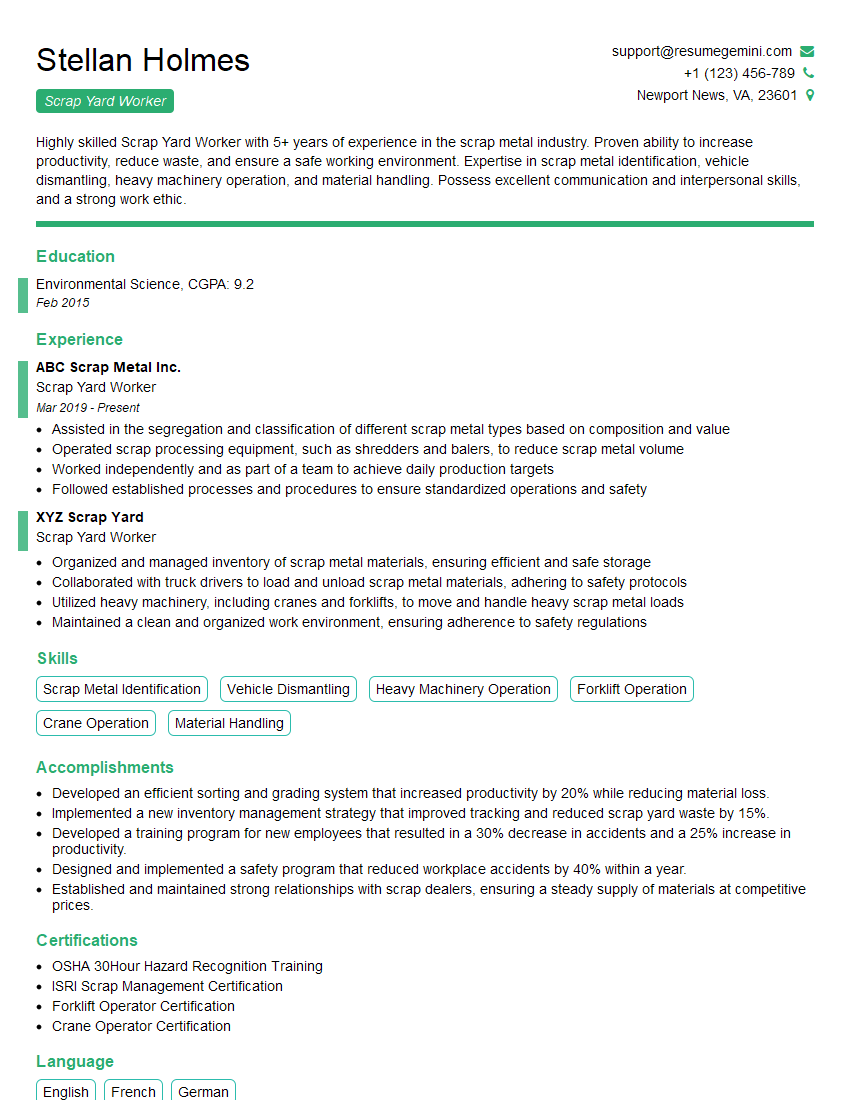
Acing the interview is crucial, but landing one requires a compelling resume that gets you noticed. Crafting a professional document that highlights your skills and experience is the first step toward interview success. ResumeGemini can help you build a standout resume that gets you called in for that dream job.






Essential Interview Questions For Scrap Yard Worker
1. What are the different types of scrap metal you typically encounter and how do you sort them?
As a scrap yard worker, I am familiar with a wide range of scrap metal types, including ferrous (iron-based) and non-ferrous (non-iron-based). Ferrous metals include steel, cast iron, and wrought iron, while non-ferrous metals include aluminum, copper, and brass. Sorting these metals is crucial for proper recycling and maximizing their value. To do this, I use various techniques such as visual identification, magnetic separation, and density-based sorting. Visual identification involves examining the metal’s color, texture, and any identifying markings. Magnetic separation utilizes magnets to separate ferrous metals from non-ferrous metals. Lastly, density-based sorting employs a water bath to separate metals based on their density.
2. How do you assess the quality of scrap metal and what factors affect its value?
Factors Affecting Quality
- Cleanliness: The presence of contaminants such as dirt, oil, or paint can lower the metal’s value.
- Size: Larger pieces of scrap metal are generally more valuable than smaller ones.
- Shape: Easily processed shapes, like sheets or bars, are more desirable than irregular shapes.
Assessing Quality
- Visual Inspection: This involves examining the metal’s surface and identifying any signs of contamination or damage.
- Spectrometer Testing: This technology can provide a detailed elemental analysis of the metal, allowing for precise quality determination.
3. What are the safety precautions you take when handling heavy scrap metal items?
- Proper Lifting Techniques: Using proper body mechanics and equipment like forklifts or cranes to avoid injuries.
- Personal Protective Equipment (PPE): Wearing gloves, safety glasses, and steel-toed boots to protect against cuts, flying debris, and impact.
- Hazard Assessment: Identifying potential hazards, such as sharp edges or unstable loads, and taking appropriate measures.
- Safe Storage: Ensuring scrap metal is securely stored to prevent collapse or accidents.
- Training: Regularly participating in safety training to stay up-to-date on best practices.
4. How do you deal with hazardous materials that may be found among scrap metal?
- Identify and Isolate: If hazardous materials are suspected, immediately identify and isolate them from other scrap.
- Contact Authorities: Notify the appropriate authorities, such as the local environmental agency, for proper disposal.
- Proper Handling: If safe to do so, handle hazardous materials carefully, using appropriate PPE and following established protocols.
- Training: Undergo training on the safe handling and disposal of hazardous materials.
5. What is your experience with operating heavy machinery, such as forklifts or cranes?
- Certification: I am certified to operate various heavy machinery, including forklifts and cranes.
- Experience: I have extensive experience in using these machines in a scrap yard environment to lift, move, and sort heavy scrap metal items safely and efficiently.
- Safety Compliance: I strictly adhere to all safety regulations and guidelines when operating heavy machinery.
6. How do you maintain a clean and organized work area in a scrap yard?
- Regular Cleaning: Regularly sweeping, clearing debris, and removing any spills or contaminants.
- Designated Storage Areas: Establishing designated storage areas for different types of scrap metal to prevent mixing and contamination.
- Efficient Sorting: Implementing efficient sorting processes to minimize clutter and facilitate easy access to materials.
- Waste Management: Properly disposing of waste materials and scrap remnants to maintain a hazard-free environment.
7. How do you work effectively as part of a team in a fast-paced scrap yard environment?
- Communication: Maintaining open communication with team members to ensure clear understanding of tasks and responsibilities.
- Collaboration: Actively collaborating with colleagues to complete tasks efficiently and support one another in heavy lifting or demanding situations.
- Adaptability: Adapting quickly to changing priorities and workload in a fast-paced environment.
- Safety Awareness: Prioritizing safety and reminding team members of proper handling techniques and hazard avoidance.
8. What is your knowledge of scrap metal pricing and market trends?
- Market Monitoring: Regularly monitoring market prices and trends to stay informed about fluctuations and industry dynamics.
- Pricing Knowledge: Understanding the factors influencing scrap metal pricing, such as supply and demand, global economic conditions, and metal grade.
- Negotiation Skills: Possessing strong negotiation skills to ensure fair pricing for both the company and customers.
9. How do you contribute to minimizing waste and promoting sustainability in the scrap yard?
- Waste Reduction: Implementing waste reduction strategies, such as recycling scrap materials and reusing equipment.
- Environmental Awareness: Promoting environmental awareness among team members and customers to encourage responsible scrap metal disposal.
- Community Involvement: Participating in community programs and initiatives focused on scrap metal recycling and waste management.
10. What are your career goals and how does this role fit into your long-term aspirations?
In my career, I aspire to grow within the scrap metal industry and contribute to its sustainable practices. This role aligns perfectly with my goals as it provides an opportunity to develop my skills in scrap metal management, safety, and environmental stewardship. Through hard work and dedication, I aim to progress into leadership positions where I can make a positive impact on the industry and the environment.
Interviewers often ask about specific skills and experiences. With ResumeGemini‘s customizable templates, you can tailor your resume to showcase the skills most relevant to the position, making a powerful first impression. Also check out Resume Template specially tailored for Scrap Yard Worker.
Career Expert Tips:
- Ace those interviews! Prepare effectively by reviewing the Top 50 Most Common Interview Questions on ResumeGemini.
- Navigate your job search with confidence! Explore a wide range of Career Tips on ResumeGemini. Learn about common challenges and recommendations to overcome them.
- Craft the perfect resume! Master the Art of Resume Writing with ResumeGemini’s guide. Showcase your unique qualifications and achievements effectively.
- Great Savings With New Year Deals and Discounts! In 2025, boost your job search and build your dream resume with ResumeGemini’s ATS optimized templates.
Researching the company and tailoring your answers is essential. Once you have a clear understanding of the Scrap Yard Worker‘s requirements, you can use ResumeGemini to adjust your resume to perfectly match the job description.
Key Job Responsibilities
Scrap Yard Workers are responsible for the safe and efficient operation of a scrap yard. They perform a variety of tasks, including:
1. Operating heavy machinery
Scrap Yard Workers use a variety of heavy machinery to move and process scrap metal. This machinery may include forklifts, cranes, and shears.
- Operate forklifts to move scrap metal.
- Use cranes to lift and move heavy scrap metal objects.
- Operate shears to cut scrap metal into smaller pieces.
2. Sorting and grading scrap metal
Scrap Yard Workers sort and grade scrap metal by type and quality. This ensures that the scrap metal is sold to the correct buyer at the correct price.
- Sort scrap metal by type, such as ferrous and non-ferrous metals.
- Grade scrap metal by quality, such as clean and contaminated metals.
3. Loading and unloading scrap metal
Scrap Yard Workers load and unload scrap metal from trucks and trailers. This involves using heavy machinery and working in a fast-paced environment.
- Load scrap metal onto trucks and trailers using forklifts.
- Unload scrap metal from trucks and trailers using cranes.
4. Maintaining scrap yard equipment
Scrap Yard Workers perform basic maintenance on scrap yard equipment. This ensures that the equipment is safe and operational.
- Lubricate and clean scrap yard equipment.
- Inspect scrap yard equipment for damage.
- Perform minor repairs on scrap yard equipment.
Interview Tips
Preparing for a Scrap Yard Worker interview can help you make a great impression on the hiring manager and increase your chances of getting the job. Here are a few tips to help you prepare for your interview:
1. Research the company and the position
Before your interview, take some time to research the scrap yard company and the specific position you are applying for. This will help you understand the company’s culture, values, and what they are looking for in a Scrap Yard Worker.
- Visit the company’s website to learn about their history, mission, and services.
- Read online reviews of the company to get an idea of the company culture and what it is like to work there.
- Talk to people you know who work in the scrap metal industry to get their insights on the company and the position.
2. Practice answering common interview questions
There are a number of common interview questions that you are likely to be asked in a Scrap Yard Worker interview. It is helpful to practice answering these questions ahead of time so that you can deliver clear and concise answers.
- Tell me about your experience working in a scrap yard.
- What are your strengths and weaknesses as a Scrap Yard Worker?
- Why are you interested in working for our company?
- What are your salary expectations?
- Do you have any questions for me?
3. Dress professionally
First impressions matter, so it is important to dress professionally for your interview. This means wearing clean, pressed clothes that are appropriate for a work environment.
- Avoid wearing jeans, t-shirts, or other casual clothing.
- Choose clothes that are comfortable and allow you to move around easily.
- Make sure your clothes are clean and free of wrinkles.
4. Be on time
Punctuality is important for any job interview, but it is especially important for a Scrap Yard Worker interview. This is because scrap yards are often busy and fast-paced environments, and employers need to know that you can be on time and reliable.
- Give yourself plenty of time to get to the interview location.
- If you are running late, call or email the interviewer to let them know.
- Don’t be afraid to ask for directions if you need them.
Next Step:
Armed with this knowledge, you’re now well-equipped to tackle the Scrap Yard Worker interview with confidence. Remember, preparation is key. So, start crafting your resume, highlighting your relevant skills and experiences. Don’t be afraid to tailor your application to each specific job posting. With the right approach and a bit of practice, you’ll be well on your way to landing your dream job. Build your resume now from scratch or optimize your existing resume with ResumeGemini. Wish you luck in your career journey!