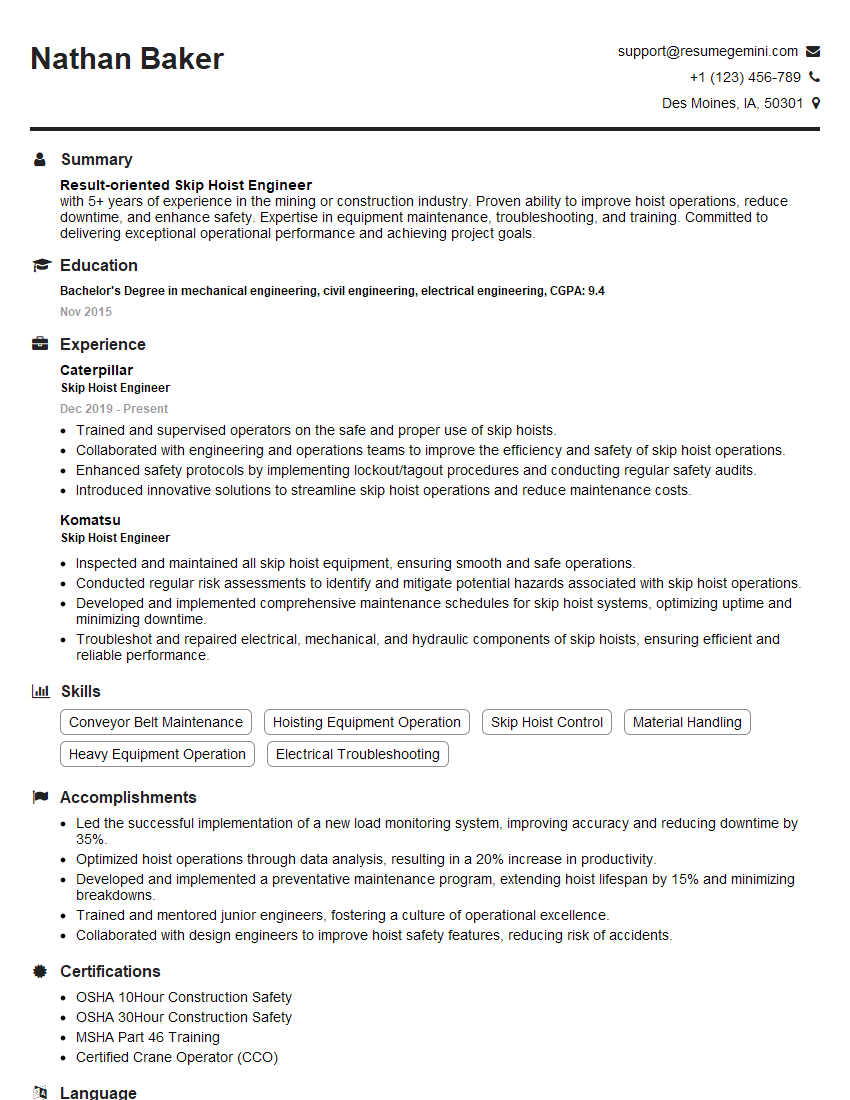
Feeling lost in a sea of interview questions? Landed that dream interview for Skip Hoist Engineer but worried you might not have the answers? You’re not alone! This blog is your guide for interview success. We’ll break down the most common Skip Hoist Engineer interview questions, providing insightful answers and tips to leave a lasting impression. Plus, we’ll delve into the key responsibilities of this exciting role, so you can walk into your interview feeling confident and prepared.
Acing the interview is crucial, but landing one requires a compelling resume that gets you noticed. Crafting a professional document that highlights your skills and experience is the first step toward interview success. ResumeGemini can help you build a standout resume that gets you called in for that dream job.






Essential Interview Questions For Skip Hoist Engineer
1. What are the key responsibilities of a Skip Hoist Engineer?
As a Skip Hoist Engineer, I would be accountable for the following tasks:
- Operating and maintaining skip hoists used in mining or construction.
- Ensuring the safe and efficient movement of materials or personnel.
- Conducting regular inspections and maintenance on the hoist and its components.
- Monitoring the hoist’s performance and identifying any potential issues.
- Troubleshoot and resolve any mechanical or electrical problems that may arise.
- Adhering to safety protocols and ensuring compliance with industry regulations.
- Maintaining records of hoist operations and maintenance activities.
- Collaborating with other engineers and technicians to optimize hoist performance.
2. Describe the different types of skip hoists and their applications.
Types of Skip Hoists
- Single-rope Skip Hoist: Used for shallow to medium-depth mines, where the hoist rope is wound around a single drum.
- Multi-rope Skip Hoist: Employed in deep mines, where multiple ropes are used to distribute the load and increase safety.
- Friction Hoist: Utilizes friction between the hoist rope and the drum to lift the load.
- Positive-grip Hoist: Employs a mechanical device to grip the hoist rope, providing a more secure and efficient lift.
Applications
- Mining: Transporting ore, waste rock, and personnel in underground mines.
- Construction: Lifting heavy materials and equipment on construction sites.
- Industrial: Moving materials in factories, warehouses, and other industrial facilities.
3. How do you ensure the safe operation of skip hoists?
Ensuring the safe operation of skip hoists involves implementing various measures, including:
- Regular Inspections: Conducting thorough inspections of the hoist, ropes, sheaves, and other components to identify any potential issues.
- Preventive Maintenance: Scheduling routine maintenance tasks to prevent breakdowns and ensure optimal performance.
- Operator Training: Providing comprehensive training to operators on safe operating procedures and emergency response protocols.
- Safety Devices: Installing and maintaining safety devices such as overspeed governors, slack rope switches, and emergency brakes.
- Compliance with Regulations: Adhering to industry standards and regulations governing the operation and maintenance of skip hoists.
- Risk Assessments: Conducting regular risk assessments to identify and mitigate potential hazards associated with hoist operations.
4. How do you troubleshoot and resolve common skip hoist problems?
Troubleshooting and resolving common skip hoist problems requires a combination of knowledge, experience, and analytical skills. Some common issues and their potential solutions include:
- Overheating: Inspect bearings, lubricate components, and check for excessive friction.
- Rope Slippage: Adjust rope tension, check for worn sheaves or drums, and inspect rope condition.
- Electrical Faults: Inspect wiring connections, check motor windings, and test electrical components.
- Mechanical Failures: Examine gears, bearings, and shafts for wear or damage.
- Hydraulic Issues: Check hydraulic fluid levels, inspect hoses and fittings, and test hydraulic components.
5. How do you optimize the performance of skip hoists?
Optimizing skip hoist performance involves implementing various strategies, such as:
- Regular Maintenance: Proactively scheduling maintenance tasks to prevent breakdowns and extend equipment life.
- Load Optimization: Balancing the load to minimize wear on the hoist and ropes.
- Speed Control: Adjusting hoist speed to optimize cycle times and reduce energy consumption.
- Operator Training: Ensuring operators are trained on efficient operating techniques.
- Data Monitoring: Collecting and analyzing data on hoist performance to identify areas for improvement.
6. What are the challenges faced by Skip Hoist Engineers?
Skip Hoist Engineers encounter various challenges in their roles, including:
- Safety Concerns: Ensuring the safe operation and maintenance of hoists, which involve heavy machinery and potential hazards.
- Technical Complexity: Dealing with complex hoist systems, electrical components, and mechanical parts.
- Environmental Conditions: Working in challenging environments, such as mines or construction sites, which can expose them to dust, noise, and extreme temperatures.
- Physical Demands: The job may require physical exertion, such as lifting heavy components or working in confined spaces.
- Shift Work: Hoist Engineers may need to work shifts, including nights or weekends, to accommodate operational needs.
7. What are the latest developments in skip hoist technology?
The skip hoist industry is continuously evolving, with advancements in technology and automation. Some recent developments include:
- Automated Hoisting Systems: Hoists equipped with sensors and control systems that enable automated operation, reducing human error.
- Remote Monitoring and Diagnostics: Systems that allow engineers to remotely monitor hoist performance, identify potential issues, and schedule maintenance.
- Advanced Rope Inspection Techniques: Non-destructive testing methods to detect rope defects and prevent failures.
- Energy-Efficient Hoists: Hoists designed to reduce energy consumption through improved components and regenerative braking systems.
8. How do you stay up-to-date with the latest industry trends and best practices?
To stay current with the latest industry trends and best practices, I actively engage in the following:
- Attending Industry Conferences and Webinars: Participating in industry events to learn about new technologies and advancements.
- Reading Technical Publications and Journals: Subscribing to industry magazines and journals to access technical articles and research findings.
- Networking with Other Engineers: Connecting with colleagues and professionals in the field to exchange knowledge and experiences.
- Pursuing Continuing Education: Enrolling in courses or workshops to enhance my skills and stay informed about emerging technologies.
9. What are your strengths as a Skip Hoist Engineer?
My key strengths as a Skip Hoist Engineer include:
- Technical Expertise: Possessing a strong understanding of skip hoist systems, electrical components, and mechanical principles.
- Problem-Solving Abilities: Proven ability to troubleshoot and resolve complex technical issues.
- Safety Focus: Committed to maintaining a safe working environment and adhering to industry regulations.
- Attention to Detail: Meticulous in inspections, maintenance, and documentation to ensure the reliability of the hoist.
- Teamwork and Communication: Effective communicator and team player, able to collaborate with colleagues and supervisors.
10. What are your career goals and aspirations?
My career goal is to excel as a Skip Hoist Engineer and contribute to the efficient and safe operation of hoist systems. I aspire to:
- Advance my Technical Skills: Continuously enhance my knowledge and expertise through training and experience.
- Contribute to Innovation: Participate in research and development initiatives to improve hoist technologies and practices.
- Assume Leadership Roles: Lead teams of engineers and technicians to achieve operational excellence.
- Share Knowledge and Expertise: Mentor and train junior engineers to ensure the future success of the profession.
Interviewers often ask about specific skills and experiences. With ResumeGemini‘s customizable templates, you can tailor your resume to showcase the skills most relevant to the position, making a powerful first impression. Also check out Resume Template specially tailored for Skip Hoist Engineer.
Career Expert Tips:
- Ace those interviews! Prepare effectively by reviewing the Top 50 Most Common Interview Questions on ResumeGemini.
- Navigate your job search with confidence! Explore a wide range of Career Tips on ResumeGemini. Learn about common challenges and recommendations to overcome them.
- Craft the perfect resume! Master the Art of Resume Writing with ResumeGemini’s guide. Showcase your unique qualifications and achievements effectively.
- Great Savings With New Year Deals and Discounts! In 2025, boost your job search and build your dream resume with ResumeGemini’s ATS optimized templates.
Researching the company and tailoring your answers is essential. Once you have a clear understanding of the Skip Hoist Engineer‘s requirements, you can use ResumeGemini to adjust your resume to perfectly match the job description.
Key Job Responsibilities
Skip Hoist Engineers are responsible for maintaining and repairing skip hoists, which are used to transport materials up and down in mines and other industrial settings. They must ensure that the hoists are safe and functioning properly.
Key responsibilities include:
1. Maintenance and Repair
- Performing regular maintenance checks and inspections on skip hoists
- Troubleshooting and repairing any problems that arise
- Ordering and replacing parts as needed
2. Safety
- Ensuring that skip hoists are safe to operate
- Following all safety regulations and procedures
- Training new employees on safety protocols
3. Communication
- Communicating with other engineers and technicians
- Reporting any problems or concerns to supervisors
- Keeping accurate records of maintenance and repairs
4. Training
- Training new employees on how to operate skip hoists
- Providing refresher training to existing employees
- Staying up-to-date on the latest skip hoist technology
Interview Tips
Preparing for a Skip Hoist Engineer interview can be daunting, but with the right approach, you can increase your chances of success.
1. Research the Company and Position
Before the interview, take some time to research the company and the specific position you’re applying for. This will help you understand the company’s culture, values, and what they’re looking for in a Skip Hoist Engineer.
2. Practice Your Answers
Once you’ve done your research, start practicing your answers to common interview questions. This will help you feel more confident and prepared during the interview. Some common questions you may be asked include:
- Tell me about your experience with skip hoists.
- What are some of the challenges you’ve faced as a Skip Hoist Engineer?
- How do you stay up-to-date on the latest skip hoist technology?
- What are your strengths and weaknesses as a Skip Hoist Engineer?
3. Be Enthusiastic and Professional
During the interview, be enthusiastic and professional. Show the interviewer that you’re interested in the position and that you have the skills and experience to be successful.
4. Follow Up
After the interview, send a thank-you note to the interviewer. This will show that you’re appreciate of their time and that you’re still interested in the position.
Next Step:
Armed with this knowledge, you’re now well-equipped to tackle the Skip Hoist Engineer interview with confidence. Remember, a well-crafted resume is your first impression. Take the time to tailor your resume to highlight your relevant skills and experiences. And don’t forget to practice your answers to common interview questions. With a little preparation, you’ll be on your way to landing your dream job. So what are you waiting for? Start building your resume and start applying! Build an amazing resume with ResumeGemini.