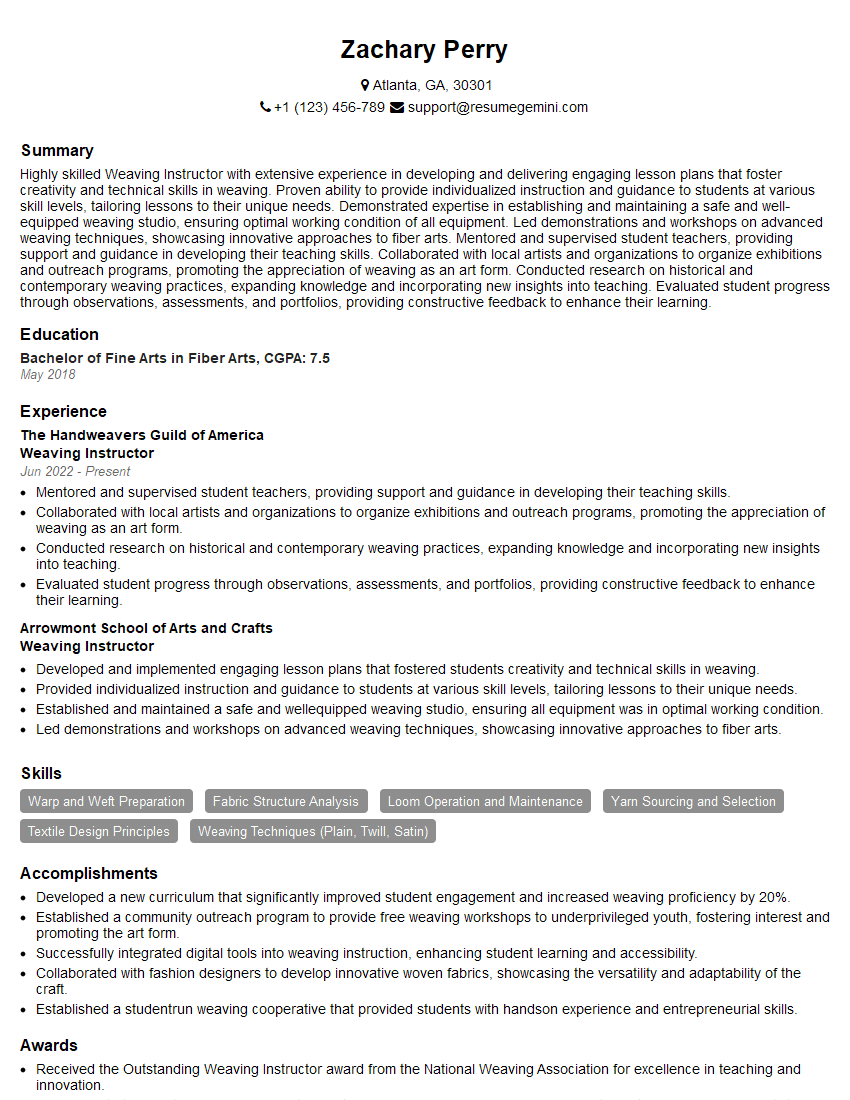
Are you gearing up for a career in Weaving Instructor? Feeling nervous about the interview questions that might come your way? Don’t worry, you’re in the right place. In this blog post, we’ll dive deep into the most common interview questions for Weaving Instructor and provide you with expert-backed answers. We’ll also explore the key responsibilities of this role so you can tailor your responses to showcase your perfect fit.
Acing the interview is crucial, but landing one requires a compelling resume that gets you noticed. Crafting a professional document that highlights your skills and experience is the first step toward interview success. ResumeGemini can help you build a standout resume that gets you called in for that dream job.






Essential Interview Questions For Weaving Instructor
1. Can you elaborate on the different types of weaving techniques and their applications?
- Plain weave: This is the most basic weave structure, and it is used to create a variety of fabrics, including canvas, denim, and linen.
- Twill weave: This weave structure creates a diagonal pattern on the fabric, and it is used to create fabrics such as gabardine, herringbone, and denim.
- Satin weave: This weave structure creates a smooth, lustrous surface on the fabric, and it is used to create fabrics such as satin, charmeuse, and velvet.
- Jacquard weave: This weave structure is used to create complex patterns on the fabric, and it is used to create fabrics such as brocade, damask, and tapestry.
2. How would you assess the quality of a woven fabric?
subheading of the answer
- The quality of a woven fabric can be assessed by looking at its construction, its drape, and its finish.
- Construction: The construction of a fabric refers to the way in which the threads are woven together. A well-constructed fabric will have a tight weave and will be free of defects.
- Drape: The drape of a fabric refers to the way in which it falls and moves. A fabric with a good drape will fall gracefully and will not be too stiff or too limp.
- Finish: The finish of a fabric refers to the way in which it has been treated after it has been woven. A well-finished fabric will have a smooth surface and will be free of wrinkles or creases.
subheading of the answer
- In addition to the above factors, the quality of a woven fabric can also be assessed by its color, its texture, and its weight.
- Color: The color of a fabric is important because it can affect the overall appearance of the garment or product that is made from it.
- Texture: The texture of a fabric refers to the way in which it feels to the touch. A fabric can have a smooth texture, a rough texture, or a textured texture.
- Weight: The weight of a fabric refers to the amount of fabric that is used to make a garment or product. A heavy fabric will be more durable than a light fabric.
3. What are the most common problems that you encounter when weaving, and how do you troubleshoot them?
- One of the most common problems that I encounter when weaving is tension problems. Tension problems can occur when the warp threads are too tight or too loose. If the warp threads are too tight, the fabric will be stiff and difficult to work with. If the warp threads are too loose, the fabric will be weak and may not hold its shape.
- Another common problem that I encounter is shedding problems. Shedding problems occur when the warp threads do not open up properly to allow the weft thread to pass through. Shedding problems can be caused by a variety of factors, including incorrect threading, incorrect timing, or incorrect tension.
- Finally, I also encounter problems with broken threads. Broken threads can occur for a variety of reasons, including incorrect tension, sharp objects, or poor quality yarn.
4. What are the latest trends in weaving technology, and how do you stay up-to-date with these trends?
- One of the latest trends in weaving technology is the use of digital weaving machines. Digital weaving machines allow weavers to create complex and intricate patterns that would be difficult or impossible to create on a traditional loom.
- Another trend in weaving technology is the use of sustainable materials. Weavers are increasingly using recycled and organic materials to create their work.
- I stay up-to-date with the latest trends in weaving technology by reading industry publications, attending trade shows, and taking workshops.
5. How do you adapt your teaching style to meet the needs of different students?
- I adapt my teaching style to meet the needs of different students by first assessing their individual learning styles.
- Once I have assessed their learning styles, I can tailor my teaching methods to match their needs.
- For example, if a student is a visual learner, I will use more visual aids in my teaching.
- If a student is a kinesthetic learner, I will incorporate more hands-on activities into my teaching.
6. How do you assess student learning and provide feedback?
- I assess student learning through a variety of methods, including observation, questioning, and written work.
- I provide feedback to students both verbally and in writing.
- Verbal feedback is often more immediate and can help students to make corrections in their work as they are learning.
- Written feedback is more formal and can provide students with a record of their progress.
7. How do you motivate students who are struggling with the material?
- I motivate students who are struggling with the material by first trying to identify the source of their difficulty.
- Once I have identified the source of their difficulty, I can develop strategies to help them overcome it.
- For example, if a student is struggling with a particular technique, I might provide them with additional practice opportunities.
- If a student is struggling with the concepts, I might provide them with additional resources or review the concepts with them.
8. How do you create a positive and inclusive learning environment for all students?
- I create a positive and inclusive learning environment for all students by first establishing a respectful and supportive classroom culture.
- I do this by setting clear expectations, providing positive reinforcement, and modeling respectful behavior.
- I also make sure that all students feel valued and respected, regardless of their background or abilities.
9. How do you collaborate with other teachers and staff to support student learning?
- I collaborate with other teachers and staff to support student learning by sharing resources, ideas, and best practices.
- I also work with other teachers to develop and implement cross-curricular projects.
- I believe that collaboration is essential for creating a positive and supportive learning environment for all students.
10. How do you stay up-to-date on best practices in weaving instruction?
- I stay up-to-date on best practices in weaving instruction by attending workshops and conferences.
- I also read industry publications and research articles.
- By staying up-to-date on best practices, I can ensure that my students are receiving the highest quality instruction possible.
Interviewers often ask about specific skills and experiences. With ResumeGemini‘s customizable templates, you can tailor your resume to showcase the skills most relevant to the position, making a powerful first impression. Also check out Resume Template specially tailored for Weaving Instructor.
Career Expert Tips:
- Ace those interviews! Prepare effectively by reviewing the Top 50 Most Common Interview Questions on ResumeGemini.
- Navigate your job search with confidence! Explore a wide range of Career Tips on ResumeGemini. Learn about common challenges and recommendations to overcome them.
- Craft the perfect resume! Master the Art of Resume Writing with ResumeGemini’s guide. Showcase your unique qualifications and achievements effectively.
- Great Savings With New Year Deals and Discounts! In 2025, boost your job search and build your dream resume with ResumeGemini’s ATS optimized templates.
Researching the company and tailoring your answers is essential. Once you have a clear understanding of the Weaving Instructor‘s requirements, you can use ResumeGemini to adjust your resume to perfectly match the job description.
Key Job Responsibilities
Weaving instructors lead and guide students or trainees by demonstrating and instructing weaving techniques and fiber arts.
1. Plan Weaving Lessons
Instructors create and implement lesson plans that introduce different weaving methods, fiber types, and specialized techniques.
2. Assess Students and Provide Feedback
Instructors evaluate students’ progress, provide constructive criticism, and guide them in developing technical proficiency and artistic expression.
3. Maintain Studio Equipment
Instructors set up, maintain, and repair weaving looms and other equipment in the workshop.
4. Prepare and Dye Fibers
Instructors prepare and dye fibers using natural or synthetic materials to create custom colors and textures.
Interview Tips
Preparing for a weaving instructor interview requires research, practice, and a genuine interest in fiber arts.
1. Research the Institution and Program
Gather information about the institution’s weaving program, its history, and the specific teaching position. This shows your interest and dedication.
2. Highlight Your Technical Skills
Explain your experience with different weaving techniques, materials, and equipment. Showcase your proficiency in both traditional and contemporary approaches.
3. Demonstrate Your Artistic Vision
Present your artistic portfolio or discuss your weaving experiences that demonstrate your creativity and understanding of the aesthetic principles of weaving.
4. Prepare Sample Teaching Materials
If possible, bring sample lesson plans or teaching aids to the interview. This gives the interviewers a tangible example of your teaching style.
Next Step:
Now that you’re armed with interview-winning answers and a deeper understanding of the Weaving Instructor role, it’s time to take action! Does your resume accurately reflect your skills and experience for this position? If not, head over to ResumeGemini. Here, you’ll find all the tools and tips to craft a resume that gets noticed. Don’t let a weak resume hold you back from landing your dream job. Polish your resume, hit the “Build Your Resume” button, and watch your career take off! Remember, preparation is key, and ResumeGemini is your partner in interview success.